

On 26th July, Paris will welcome 14,000 athletes from 206 countries, 9 million audience members and 4 billion television spectators to join the Olympic Opening Ceremony. French President Emmanuel Macron has articulated a vision for a “wide open” Games designed to spread opportunities and maximise the benefits for the long-term unemployed, small businesses and deprived communities. In his new year’s address Macron predicted the “Paris 2024 Games will leave an indelible mark on Paris and on the French people”. I seek to analyse the positive and negative economic impacts that the 2024 Olympic games will have on France.
Positive Impacts from the Olympic Games:
The French Olympic Committee objectives for the 2024 Olympic Games included re-generating the urban area of Saint-Denis as well as bringing benefits to the wider French economy and society.
- Local Urban Regeneration in Saint-Denis: The Olympics will take place in Saint-Denis – an area of Paris, with some of the highest levels of unemployment (>20%), poverty rates (33% of the population) and rates of social housing (40%) in France[1]. The games will bring long-anticipated investment to the area, including the construction of 5,000 new housing units and the upgrading of basic infrastructure (the electricity grid, adding a motorway noise barrier, redevelopment of the Canal Saint-Denis). In addition, the authorities want to have a positive environmental impact. They are re landscaping green public spaces, adding cycling lanes and building the Aquatics Centre for the long-term use of local residents in an area previously lacking in sports facilities. This will help the environment by encouraging people to cycle instead of using cars, and encouraging people to be more active (sporty).
[1] Liz Alderman, “Can the Olympics Rejuvenate One of France’s Poorest Corners?”, New York Times, 20th Feb 2024
- Economic Benefit: A study conducted by the Centre for Law and Economics of Sport (CDES) at the University of Limoges[2] estimated that the Games could generate €10.7 billion in economic benefits and create more than 250,000 jobs.
- Driving Tourism: An estimated 15.3 million visitors are expected to visit Paris and its surrounding areas during the Olympics, with an estimated 3.3 million of these as attendees[3]. The French think-tank, Le Centre de Droit et d’Economie du Sport, estimates a potential €3.5 billion injection from foreign tourism into Paris.
- Employment is a priority for Paris 2024, with a focus on creating jobs in the Ile-de-France region across different sectors including, tourism, catering and construction. A Social Charter was agreed with trade unions and employer organisations in 2018 to use the Games to benefit the long-term unemployed and vulnerable groups. Solideo, the state’s Olympic building company, recently announced that it has provided 30,000 people with contracts working for the games, with 6 percent being formerly unemployed residents of Seine-Saint-Denis[4].
- Boosting Small Business: Paris 2024’s sustainable procurement strategy, a strategy formed with the target of recognising socio-economic as well as environmental responsibilities, is targeting 90% French suppliers, of which 75%, or 1,200, are small-medium-sized enterprises (SMEs). Paris 2024 will purchase roughly €2.5 billion worth of goods and services, or €5 billion including the contracts that Solideo, public contracting authorities and private customers, will award in preparation for the Games.
- Attracting some Foreign Direct Investment including Elon Musk’s French Tesla headquarters and the future HQ of France’s domestic intelligence service, the DGSI.
- Environmental and Social Benefits: Paris 2024 aims to halve greenhouse gas emissions from the 3.5m tonnes of CO₂ emitted on average by previous summer games[5]. They will also try to clean up the river Seine, through multiple strategies, including draining out litter. In addition, organisers hope that the Games will promote a wider set of intangible benefits including health and well-being, education, and inclusion across France. Since 2020, the French government has invested EUR 38.7 million into 1000 projects. In total this has benefitted over 3.1 million people, by encouraging them to focus on their health and wellness, through sports. Its difficult to quantify a monetary benefit from these initiatives, although there is likely to be many meaningful benefits.
The Negative Impact of Hosting The Games:
However, not everyone shares Mr Macron’s vision to turn the Games into a “popular celebration and an economic success”. Critics (including many Parisians) suggest that the Games will incur significant costs (construction of mega facilities, cost of opening ceremony and security). Inflationary pressures have raised the cost of the Paris games to an estimated €8.8 billion, up from €6.6 billion in 2017 (excluding security costs). Furthermore, critics argue the Games will not bring any long term, sustainable benefits as the extra jobs and economic activity will only be temporary. This will further in-debt the French State and Paris Municipality, which will need to be funded by tax increases.
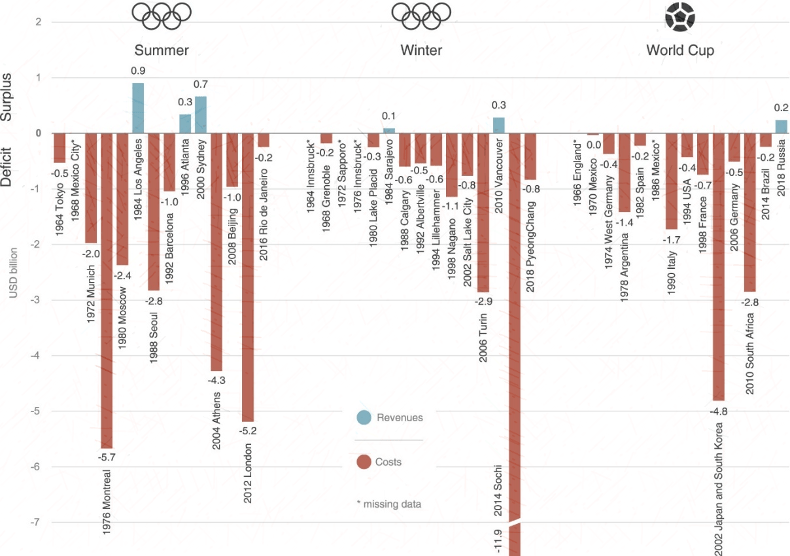
Empirical analysis from past Olympic Games tells us the event is more often than not a financial drain. Research by Martin Muller at the University of Lausanne[6], compared the revenues and costs of the Olympic Games and World Cups between 1964 and 2018 (N = 43), together totalling close to USD 70 billion in revenues and more than USD 120 billion in costs. He found that costs exceeded revenues in four out of five Olympics and World Cups.
[1] Liz Alderman, “Can the Olympics Rejuvenate One of France’s Poorest Corners?”, New York Times, 20th Feb 2024
[2] “Paris 2024, Etude D’Impacte, Le Centre de Droit et d’Economie du Sport, Published in 2016
[3] “What Travellers Should Know About the APris 2024 Olympics”, Lacey Pfalz, Oct 2023
[4] Liz Alderman, “Can the Olympics Rejuvenate One of France’s Poorest Corners?”, New York Times, 20th Feb 2024
[5] “Magical Olympics will be worth the disruption, promises Paris 2024 Chief”, Leila Abboud, 20 December 2023
[6] M. Muller, “The structural deficit of the Olympics and the World Cup: Comparing costs against revenues over time” May 2022
Muller also considers the deficit/surplus in relation to the total cost, also known as the return on investment (ROI), which had an average of -38%, with mean costs of USD 2.8 billion exceeding mean revenues of USD 1.7 billion per event. These were divided in to 4 quadrants. (This refers to previous Olympic games but also World Cups).
- The ‘lean and mean’ quadrant including profitable events with low costs eg Los Angeles 1984 (ROI of c. 200%), Sarajevo 1984, Atlanta 1996 and Vancouver 2010;
- The ‘cash cows’ quadrant including expensive but profitable events: Sydney 2000 is the only to make it into that zone;
- ‘Tiny Tragedies’ – Until about the end of the 1980s, most of those had total costs below $3 billion;
- Big Busts” – From the 2000s onwards, as costs kept rising but ROIs did not improve e.g. Sochi, 2014 with an ROI of −79%, Japan/South Korea 2002 at−66%, London 2012 at−47%).
For Paris 2024, the French Government are hoping to avoid these past examples and hoping to use the Games to their financial advantage. Therefore, they are aiming for a ‘cash cows’ quadrant.

In Conclusion:
We will not know whether the Paris 2024 will generate a positive or negative return on investment until after the Games. What is certain is that it will generate many benefits for the local community of Saint Denis and the wider Parisian economy, as well as supporting President Macron’s ambition to project soft power on the global stage. It will be a spectacle for sure!
 etonomics.com