Has Economics Run Out Of New Big Ideas?

Economics is often criticised for being a reactionary science that predicts nothing and only explains its mistakes (Rodrik, 2015). It is rarely credited with discoveries that help society; and in a random survey, most participants did not trust economists (Economics Network, 2017). Instead, economists are criticised for their resistance to change and for limiting the exploration of real-world practical policy solutions. Moreover, it is true … Continue reading Has Economics Run Out Of New Big Ideas?

Chart of the Month – August 2023

August’s Chart of the Month shows the number of Santander cycles hired from 2015, when Santander began sponsoring the scheme in London, to 2023. It shows long term growth, culminating in 2022’s record-breaking year of 11,506,889 hires. However, more recently, usage has been low and recovery has been slow. The Santander Cycle hire scheme is owned by the Transport For London (TFL), a government body … Continue reading Chart of the Month – August 2023

Chart of the Month – May 2023

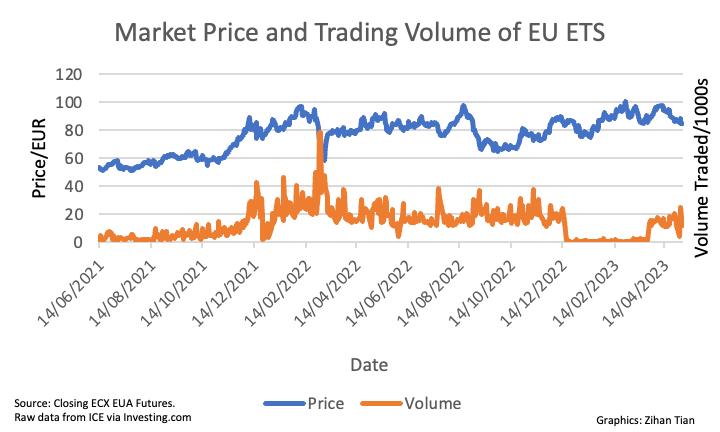
This Chart of the Month revisits the EU Emissions Trading Scheme (ETS). An explanation as to how it works can be found in the July 2021 Chart. In that article, we asked whether the EU ETS could hold its value, and whether the increase in costs of pollution would prove too great a burden for firms and the poorest households. Now, we can try to answer … Continue reading Chart of the Month – May 2023

The World should be More Careful with Automation…

The question of automation replacing jobs has been especially debated in recent times. This was initially because of COVID-19, which substantially increased investment into developing new technology due to skyrocketing demand for digital goods. Then, with the breakthroughs in artificial intelligence (AI) research, such as the invention of ChatGPT, the public has begun to worry about higher skilled jobs being at risk too. This essay … Continue reading The World should be More Careful with Automation…

Chart of the Month – March 2023

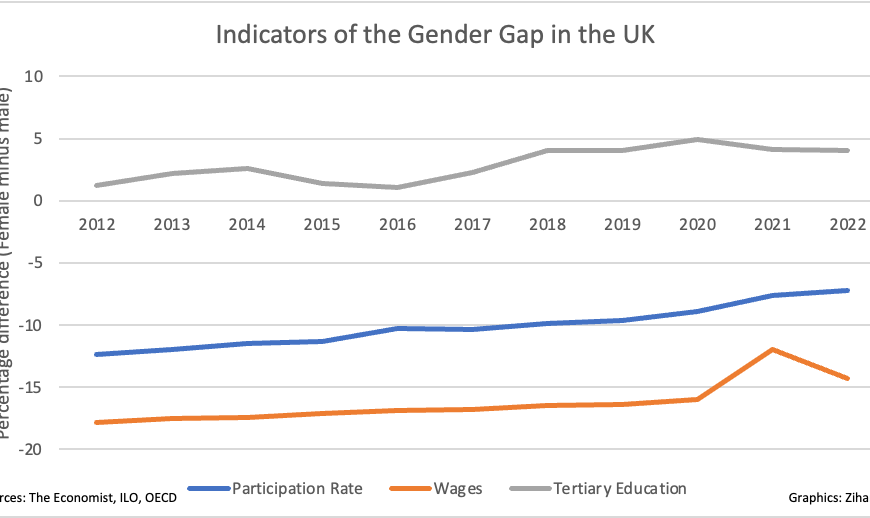
March’s Chart of the Month displays the percentage differences in tertiary education, participation in the workforce, and average wages, between women and men in the UK. It highlights the gender disparities that still exist within the labour market. For instance, in 2020 average wages for female workers were 15% lower than for men, yet they were 5% more likely to be in tertiary education. Over … Continue reading Chart of the Month – March 2023

Chart of the Month – February 2023

Strikes in the UK are at a record high. February’s Chart of the Month examines the causes behind this unparalleled increase of discontent in wages and its implications on the UK’s economic recovery. In the last 10 years, there have been two spikes in working days lost to strikes. Over several days in July 2014, millions of people took part in protests, including teachers, firefighters, … Continue reading Chart of the Month – February 2023

Reviving the tiger: Ireland’s property struggles

In Ireland, hidden behind a guise of Guinness, pubs and charm, homelessness runs rampant. The soaring price of houses has made renting the far more attractive alternative. But landlords have seized the opportunity to increase the price of rents too. It is estimated that 50,000 new homes need to be constructed every year in order to ease the shortage, but the real rate of construction … Continue reading Reviving the tiger: Ireland’s property struggles

Tourism and Development: the path less travelled

Recent decades have seen an unprecedented amount of economic development as ’emerging nations’ have sought to raise incomes per capita and reduce levels of absolute poverty. Their economies have grown, and citizens have experienced an improvement in their overall standard of living.  Developing countries share some characteristics such as lower growth, lower standards of living, worse education, and lower life-spans, when compared to developed countries. Many … Continue reading Tourism and Development: the path less travelled

How Far Can Central Banks Chain Inflation?

After interest-rate cuts and huge quantitative easing in 2020, investors felt that central-bank stimulus would last forever. But free money was coming to an end as COVID-stricken economies began to recover. A tide of inflation was carried alongside them, reaching peaks not seen for 40 years. Central banks scrambled to minimise the impact by increasing rates; the Bank of England (BoE) was first, announcing rate … Continue reading How Far Can Central Banks Chain Inflation?