
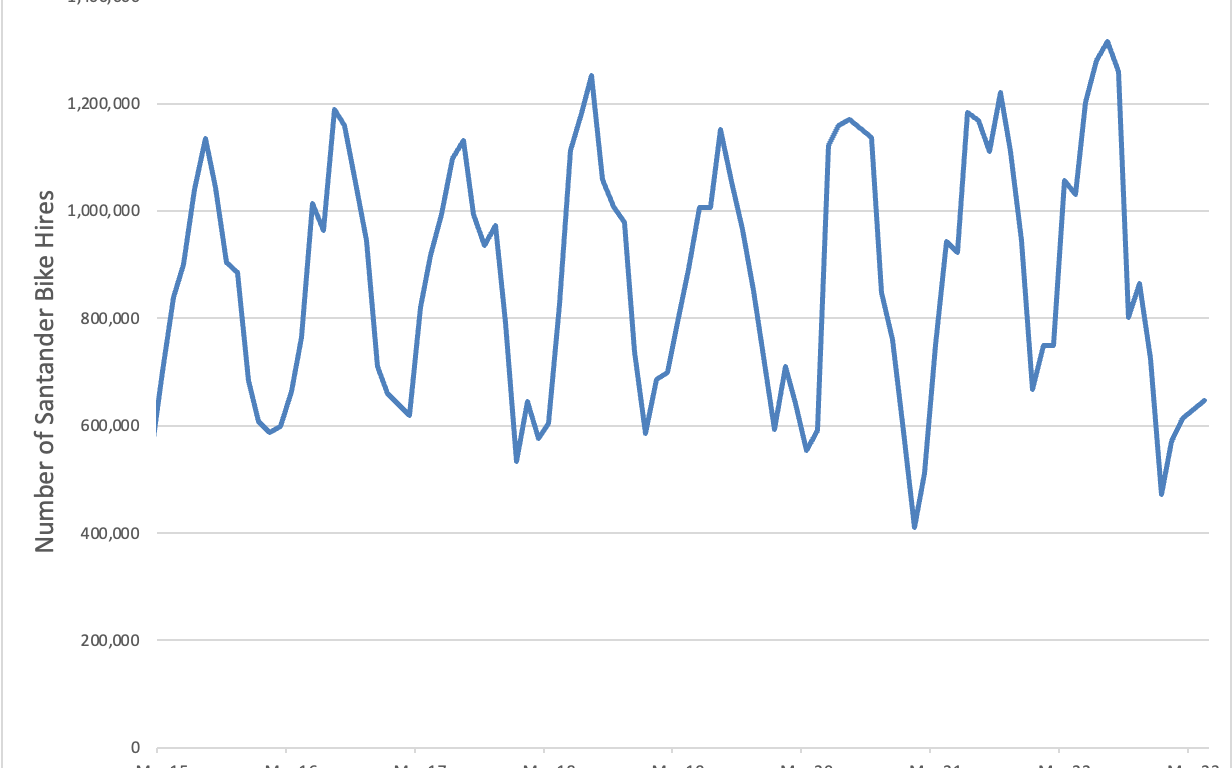

August’s Chart of the Month shows the number of Santander cycles hired from 2015, when Santander began sponsoring the scheme in London, to 2023. It shows long term growth, culminating in 2022’s record-breaking year of 11,506,889 hires. However, more recently, usage has been low and recovery has been slow.
The Santander Cycle hire scheme is owned by the Transport For London (TFL), a government body which is also responsible for the London Underground, buses, taxis and river services. Around 800 bicycle docking stations are scattered across London, making it exceptionally easy for riders to locate, hire and return bikes. The scheme aims to promote sustainability and being more active.
Since 2012, it would cost a Londoner £2.00 for access to these bikes for 24 hours, given they make a stop at one of the designated bike docks every half hour and pay with the same card they originally used. Under this system, only around 5% of 30 minute journeys earned revenue, as the rest of them were covered under the 24 hour access. As a result, the scheme was running at a heavy loss and even with Santander’s sponsorship of around £7mn a year, the government also had to pay around the same amount in subsidies.
On 12 September 2022, the TFL reworked the pricing system. Now, £1.65 is the barrier to a single 30 minute ride. From the chart, we can see some of the effects of this; although the dip in ridership late last year could be attributed to seasonal fluctuations (people prefer not to cycle in the cold), the recovery has not been as quick as past years. On average, by April, ridership is 55% more than it was the previous December, but this year it has only been 37%.
While the number of journeys has decreased, the revenue generated for the scheme has increased as a result of fares being charged for every journey. At the same time costs of maintenance for bikes has decreased, because of less use. The size of the loss from the cycling scheme is now decreasing; the TFL doesn’t have to pay subsidies as large as they used to.
The cycling price revamps are part of a bigger structural change within TFL as they attempt to reduce the amount of subsidies they need to provide and help the government’s fiscal position. In fact, in the financial year 2023/24, TFL as an organisation is predicted to earn a profit of £79mn, which it will reinvest.
This will be the result of cost-cutting and higher fares across all its services. The latest price rise was in March: the TFL increased prices of Tube and Bus journeys by 6%, and announced that another 4% rise will happen in 2024/25. However these price increases may have negative consumer impacts.
The cuts in subsidies are not met with cuts in taxes or congestion charge, meaning the price increases are not matched by increases in disposable income. With more than a quarter of workers in London using TFL’s public transport daily for work, people can spend hundreds of pounds monthly on transport alone. Given that there aren’t many substitutes for the TFL’s services, people end up having to bear the brunt of the higher prices.
Moreover, the increase in prices are regressive, meaning they have worse effects on low income groups. This is because lower income groups are far less likely to own their own vehicles, and transport costs represent a larger proportion of their incomes, meaning price increases are a heavier burden for them to bear. They may have to sacrifice other things which they could have bought, or they may be priced out of travelling by bike or on the tube, and be less productive because it takes longer for them to get to their jobs.
An interesting question is why people have switched away from bikes and to public transport, despite price increases in both. Since March’s fare increases, bus travel actually increased by around 5%. This may be a result of how the pricing system has changed; now, people have to pay £3.30 for two bike journeys, where previously £2.00 would have covered it. This marks a 65% increase in price, much steeper than the 6% increase in public transport.
Switching away from cycling can also have negative effects on the environment and on people’s health. Cycling produces 33% less carbon emissions per kilometre than using the underground, per person, and 80% less than the bus. In addition, cycling instead of public transport reduces the risk of both physical illnesses such heart disease and mental illnesses such as depression, and GPs have already begun prescribing cycling as a way to reduce the burden on the NHS.
One potential solution the TFL could try to prevent these harms is employing third-degree price discrimination, which it already uses for the underground and the bus, charging different rates for different age groups; under 18s can submit their IDs to apply for an oyster card. The TFL could apply the same method for income groups by requiring household income reports to give different cards to different groups to alleviate the pressure from lower income groups and charge the wealthy more.
However, this would likely lead to higher administrative costs as it is significantly harder to validate income than age. This would also require everyone to be part of the Santander bike membership system, which currently accounts for just over 50% of all hires. With membership being a barrier to entry, there may be the unintended consequence that casual users may decide not to choose bikes as a method of transport.
Behavioural economics could also be applied to nudge people back towards cycling. Without changing prices, TFL could make bikes more appealing by making them a social activity, such as having ad campaigns encouraging people to ride with friends. They could also create goals for people in London to meet, with low cost rewards, such as every tenth ride being free. This can encourage people to commit towards cycling by playing on people’s competitive spirit and desire for a bargain, by setting an easy target. The biggest issue with these policies are that their results are often hypothetical; it is difficult to guarantee that people will behave in a certain manner.
The harms of the price increases on TFL’s customers appear more important than the benefits to the government’s fiscal position. The profits generated from TFL’s price hikes account for just over 0.05% of the UK’s annual deficit. Meanwhile, without growing incomes, consumers face the risk of lower living standards, having to spend a larger part of their existing incomes on necessary commutes, and may live less healthy lives. This may also put burdens on other government bodies such as the NHS, leading to more government spending elsewhere. TFL should either hope for growth and higher wages, or rethink its fares.
Question of the month:
How can the TFL and other similar organisations increase profits without harming the welfare of their consumers?
 etonomics.com