

For centuries, discussions surrounding overpopulation and its potentially devastating effects on our environment, resources, and economy have dominated the field. However, a new phenomenon is beginning to attract people’s attention: depopulation. As birth rates plummet around the globe—in both high-income countries and low-income countries—our world may at some point see the first reduction in global population since the bubonic plague in the 1300s.
A global transition to fewer births:
From Europe to East Asia, countries are experiencing a demographic decline. A well-known example of this is Japan, where fertility levels are currently 40% below replacement (defined as the average number of children a woman must have to maintain a stable population size, is typically 2.1 births per woman in developed countries). This leads to a smaller younger population compared to the elderly population, leading to an ageing population. Similarly, Europe is struggling to keep its population steady, relying on immigration. South Korea’s fertility rate hit a record low of 0.78 births per woman in 2022, making it the lowest in the OECD. Shockingly, even China – synonymous with its rapid population growth – has seen a recent decline in population growth because of its previously strict family policies.
Although I have only mentioned a few examples, it is essential to recognise that this decline can be seen across the globe: the United Nations predicts that over 20 countries could see their populations halved by 2100. This rapid shift in population will result in many changes in society, most notably within the economy.
(Graph of total population increase/decrease in Japan)

A strain on economic growth:
Economic growth has often been tied to an increasing labour force. Typically, more people working means that overall productivity increases and an increase in consumer spending – which is a core component of aggregate demand: Aggregate demand = Consumer spending + Investment + Government spending (Exports-Imports) [AD = C+ I+ G + (X-M)]. A decline in the birth rate means that there will be fewer new citizens who will join the labour force. Therefore, at some point, the number of people leaving jobs will greatly supersede the number of people beginning to work, resulting in a shrinking of the labour force.
This also means that there is less consumer spending so that aggregate demand will decrease. A decline in young people entering the workforce will also mean that businesses will struggle to find talent, leading to potential wage inflation and ultimately reduced competitiveness on the global stage. As a result of all these factors, businesses will be less willing to invest (I), resulting in an even more dramatic decrease in AD.
The economic burden of ageing populations:
One of the first challenges that depopulation will bring forth is the economic burden of an ageing population. Modern medicine will allow people to live longer, but the working population will shrink rapidly, putting immense pressure on social welfare systems. Critical economic plans, such as pensions, social services, and healthcare, will have to adapt to the larger elderly population, putting a strain on government budgets, which potentially means that taxes may have to be raised to alleviate the stress.
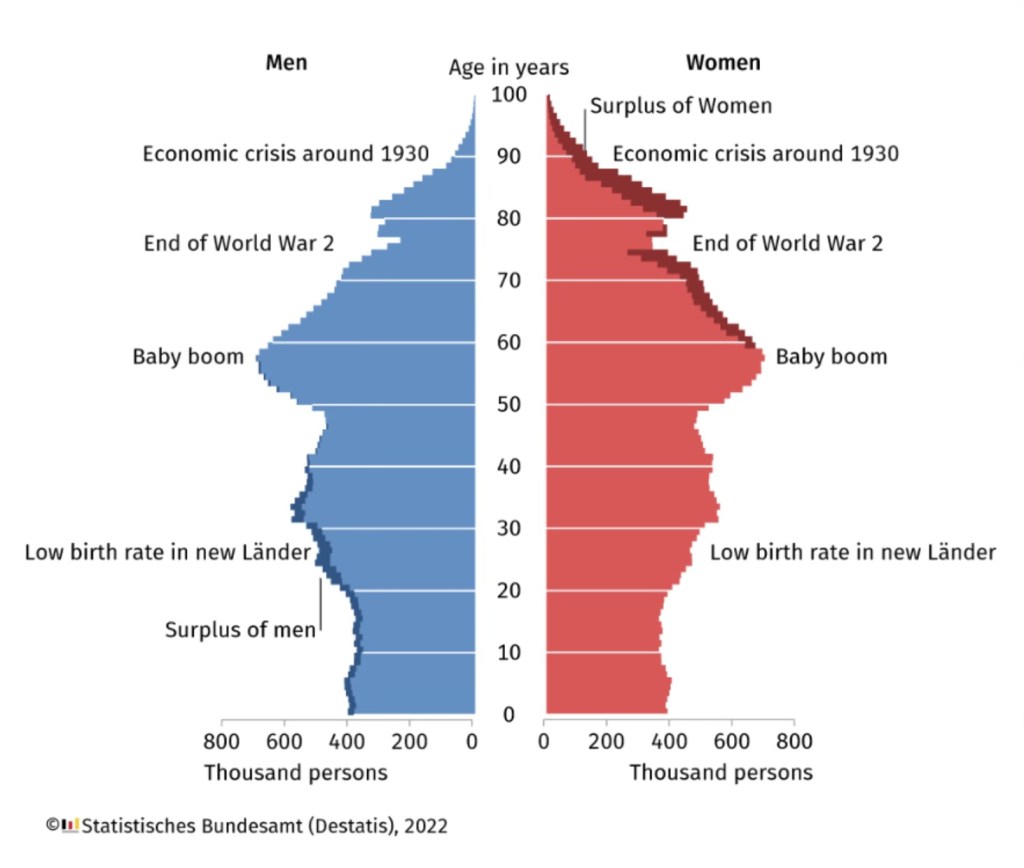
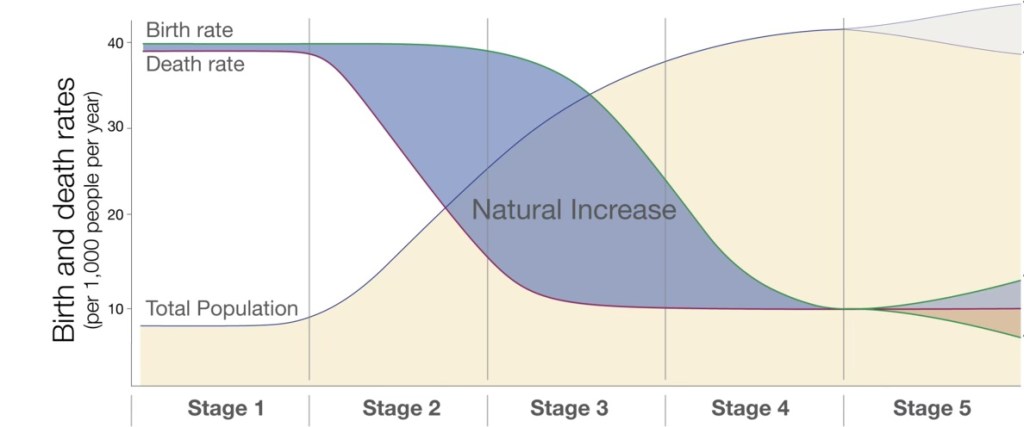
Ageing populations can be seen today; for example, Germany is amongst only six other countries worldwide to have reached stage 5 in the demographic transition model (shown below). This model illustrates the relationship between birth rates, death rates, and total population size over time, where Stage 5 is the point at which the birth rate dips below the death rate, resulting in a ‘natural decrease’. Without sufficient reforms, countries such as Germany, Ukraine, and Greece will experience public financial difficulties.
(Age Structure Of The Population In Germany)
(Demographic Transition Model)
Real estate and the ghost town phenomenon:
Depopulation will not only affect the labour force but will similarly have a significant impact on real estate. In rapidly ageing and shrinking towns, people will start to move out, causing a phenomenon known as a ‘ghost town’. An article by the Guardian in 2021 – titled ‘As birth rates fall, animals prowl in our abandoned ‘ghost towns” – reveals that this is even a problem in our society today. For example, Spain has seen a massive boom in ghost towns to the point where José Benayas, a professor of ecology at Madrid’s University of Alcalá, believes that forest coverage in Spain has tripled since 1900 (from 8% to 25%), as greenery slowly seeps into abandoned homes. As demand in these areas falls, house prices plummet, leading to economic stagnation and diminishing local tax revenues. As a result, those regions have an overall decrease in economic well-being.
However, the ‘ghost town’ phenomenon is not all bad. It helps to reduce house prices within urban areas, and people are able to move to the countryside for a cheaper price. Although this may be a benefit, real estate markets and industries will suffer greatly as the demand for the construction of new homes will greatly fall.
Innovation and the ‘silver economy’:
The era of depopulation will not be all that bad; history has shown us that in times of scarcity, we tend to innovate, as shown in the agricultural boom in 18th-century Britain. The increasing population posed a significant threat to Britain’s food security, so they developed critical systems to solve the problem: the establishment of land to create large farms, selective breeding, and the mechanisation of seed sowing.
One such industry that could become prevalent in the age of depopulation is the ‘silver economy,’ which refers to the industry revolving around elderly people. A wide array of goods and services—such as pensions, home care services, and entertainment—could be adapted to meet the demands of ageing populations, which could help counteract the decline in growth elsewhere.
An example of such a shift in goods and services can be seen in China, where a large insurance company, Ping An Group, has started to offer an extensive ecosystem for elderly people. This ranges from a smart health monitoring system and a round-the-clock medical consultancy to organising travel. In recent years, the Ping An Group has seen massive growth because of its senior care ecosystem: its Life and health business experienced a 36% year-on-year growth in 2023, of which the senior care ecosystem contributed 70%.
The role of automation and AI:
Another solution to the shrinking working-age population would be to integrate AI and automation into the workforce. This would allow mundane jobs to be taken over by robots and leave more important jobs to the remaining population. A report published in March 2024 by Goldman Sachs estimated that AI could replace the equivalent of 300 million full-time jobs. This shift would alleviate the stress of the change in our economy.
However, the widespread adoption of automation would bring its own set of challenges, most notably a massive investment in digital infrastructure. This could be problematic as pre-existing infrastructure may need to be destroyed or simply replaced, resulting in a higher cost than anticipated.
Another problem is that certain people could be displaced by automation but would not have the necessary education or skills to take up another job, so the number of unemployed could rise, and these countermeasures would almost have the opposite effect intended.
Conclusion:
As the world navigates through an era of depopulation, the challenges it presents are undeniable, from strained social welfare systems to shrinking labour markets and declining consumer demand. The economic landscape that we have long associated with perpetual growth may need to adapt to a reality where fewer people drive innovation, productivity, and consumption. However, as history has shown, periods of scarcity often breed ingenuity. The rise of the ‘silver economy’ and advancements in automation and AI offer glimpses of how societies might adapt to these demographic shifts.
However, the transition will not be seamless. Governments will need to grapple with the burden of ageing populations, businesses will have to rethink their strategies, and economies will need to find new engines of growth. Ultimately, while depopulation brings challenges, it also presents an opportunity to reshape our economic systems to become more sustainable, efficient, and resilient for the future.
Bibliography
https://www.foreigna?airs.com/world/age-depopulation-surviving-world-gone-gray-nicholas-eberstadt
https://www.nippon.com/en/japan-data/h02015/
https://en.wikipedia.org/wiki/British_Agricultural_Revolution
https://www.ft.com/partnercontent/ping-an-insurance/unlocking-the-silver-economy.html
https://www.bbc.com/worklife/article/20230418-ai-anxiety-artificial-intelligence-replace-jobs
 etonomics.com