
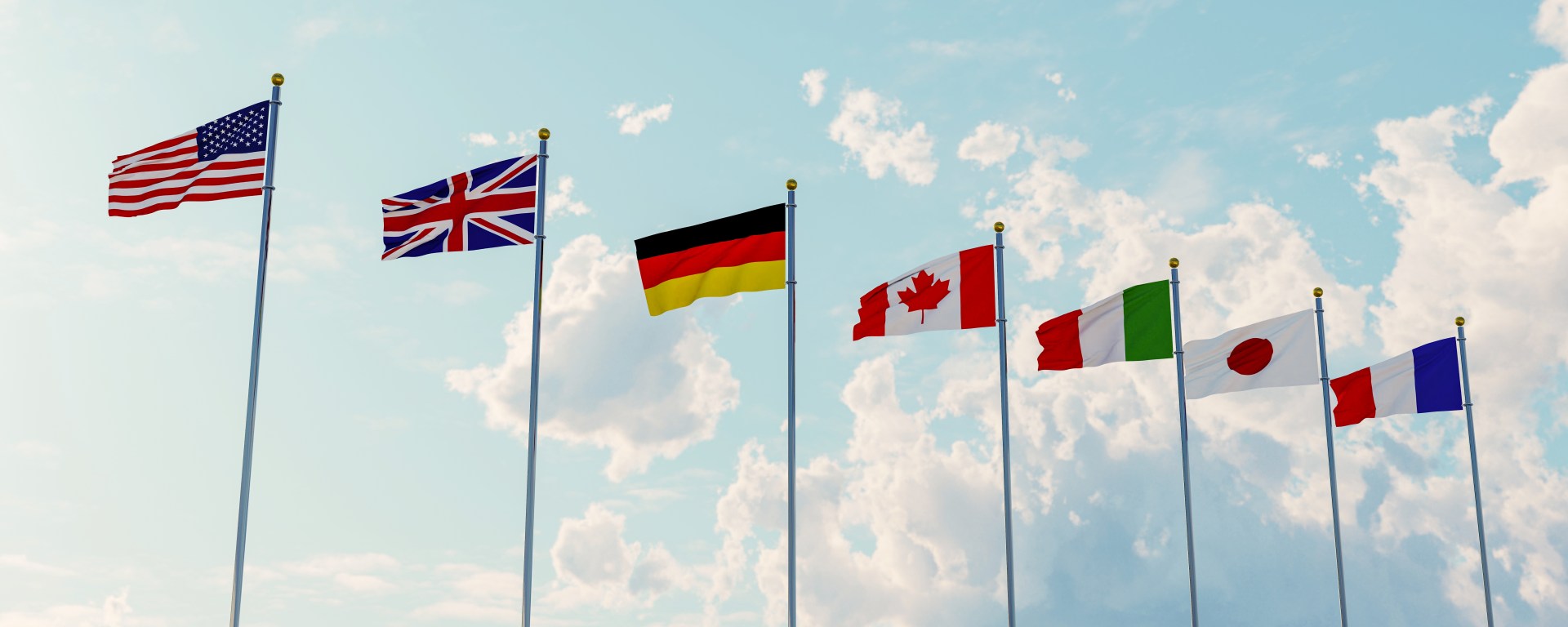
The Group of 7 (G7), containing the countries of Italy, Canada, France, Germany, Japan, the United States, and the United Kingdom is a political and economic forum made up of some of the world’s most historically significant major economies. However, it is worth noting that the G7 excludes two of the world’s economic giants, China and India, which are both among the top five economies in the world. In the world of today, does the original G7 still hold the same significance? Or should they be referred to as “W7: The Waning 7”?
However as impressive as these two developing nations are it is disputable whether they truly can compete with giants such as Canada, the second largest country in the world. At first glance, it’s economic performance seems to match up to its geographical title; a GDP of 2.2 trillion leaves it in ninth on the global scale, the country’s per capita of $53,000 leaves it in 18th worldwide and 3rd for any major economy. It appears then, that Canada should be considered to be part of this prestigious group. Indeed the Toronto Stock exchange is one of the largest in the world with a combined valuation of $2 trillion. Canada’s cooperative banking sector also excels, possessing the world’s highest per-capita membership in credit unions. Yet, it might be the softer skills where the Great White North is most impressive in, ranking 2nd best for any major economy in the Corruption Perceptions Index (12th in the world). While housing affordability and foreign direct investment are hard to be found, what can be found is a giant energy sector consisting of vast offshore deposits of natural gas and enough oil-fields to make Canada possess the fourth largest oil reserves in the world, possessing 13% of the world’s supply. Therefore, while Canada currently has low growth along with some other economic problems, it has a hugely diversified economy, with its abundant natural resources, advanced manufacturing and world class service sectors, all alongside its minimal corruption. So perhaps Canada does deserve its spot in the G7?
Another country worth considering is France: the world’s leading tourist destination since 2015. In comparison to other large economies, France’s economic performance is impressive: A GDP of just over 3 trillion ranks it seventh in the world, while it’s per capita of $46,000 leaves it third for any major economy. Furthermore, the country is hardly a newcomer to these economic successes, being in the top 10 largest economies globally for the last two centuries. If you look deeper, the stats still fail to disappoint: In 2019, France was ranked as receiving the largest FDI in Europe. Furthermore, according to the Bank of France, the Paris region also contains the highest concentration of multinational firms in Europe. Strong policy choices have also helped France innovate, ranking 9th in Bloomberg’s innovation index. Therefore France, despite its relatively small growth compared to its Asian counterparts, is undoubtedly a deserving member of the G7.
Italy, although renowned for its architecture and cuisine, is also an economic powerhouse in its own right: a GDP of $2.18 trillion ranks it 8th largest globally and 4th in Europe. Furthermore, the country is also ranked 30th in the human development index, a sound score. As the world’s sixth largest manufacturing nation, it competes with Asian competitors in quality while keeping production high, seen with luxury brands like Gucci and Versace. The famous Italian automotive industry, contributing to 8.5% of the country’s GDP, features iconic companies like Maserati, Pagani, Lamborghini, and Ferrari. However, Italy does face many challenges, including a stagnating economy after the 2007-8 financial crisis, which caused large debt problems. Other problems include the North-South economic disparity is significant, with northern cities earning up to 152% of GDP per capita compared to the South’s 61%. Other indicators, such as unemployment stand at a stubbornly high 11%, with the North at 6.6% and the South at 19.2%. Youth unemployment especially is a concern at 31%. Despite these issues, Italy’s diversified economy, including luxury products and vehicles that ensuring quality over quantity allow the country to somewhat maintain the country’s strong position in the G7.
Germany, the largest economy and the second-largest population in Europe, boasts a GDP that ranks third-highest globally and fourth highest per capita income among major economies. Furthermore, a remarkably low unemployment rate of 3.2% places it fourth lowest in the EU. As the birthplace of the modern car, Germany’s automotive industry is unsurprisingly dominant, ranking sixth in the world by production. Home to renowned car companies like Volkswagen, the second-largest automotive manufacturer globally in terms of both production and sales also has 32 Fortune 500 companies headquartered in the country. However, Deutschland is not immune to challenges: in 2023, Germany experiencing a 0.3% contraction in the economy and 0.2% in 2024. While recent predictions from Goldman Sachs suggest a meagre 0.3% growth for 2025, Germany’s Human Development Index nevertheless remains strong, securing the highest position among major economies. Therefore, despite the uncertainties ahead for the German economy and its dependence on exports to China, it is undeniable that Germany deserves its place in the esteemed G7 group.
Japan, renowned for its delicious cuisine and rich culture, also boasts one of the world’s most robust economies: with the fourth-largest GDP globally and the eighth-largest GDP per capita among major economies. However, Japan’s economic landscape can be compared to the dramatic Japanese Alps: despite the country’s unemployment rate hovering just below 3%, Japan grapples with a significant poverty rate of 15.7%, placing it as the second-highest among G7 nations. Moreover, Japan holds the distinction of having the highest ratio of public debt to GDP among major economies, an alarming figure of 248%. Nevertheless, as a global powerhouse, Japan ranks fifth in terms of exports, primarily exporting automotive vehicles, steel, iron, and semiconductors. However, its economic prowess is complemented by its status as the world’s fourth-largest importer, actively purchasing machinery, foodstuffs, and fossil fuels among other commodities. Yet Japan’s tourism industry has experienced steady growth, ranking 11th globally for inbound tourism and securing the top spot in the 2021 Travel and Tourism Competitive Report. Like many other G7 nations, Japan is currently facing challenges related to economic stagnation, and while the title “Land of the Rising Sun” may not fully encapsulate its current economic state, Japan continues to be celebrated by some as the most sophisticated and advanced country in the world, meaning they deserve their spot in the G7.
The USA, can be characterised by one word : Large. The world’s third largest country by land area and population boasts the worlds largest GDP at over 29 trillion, as well as having the highest per capita income globally at $86000. The US is also top of the leaderboard in many other respects: notably, 136 Fortune 500 companies have US headquarters. However, despite the country’s renowned industrial prowess, the wealth gap is significant, with the top 10% holding 72% of household wealth and the lower 50% just 2%. Therefore, it is unsurprising the US also leads in volume of billionaires and millionaires at 8% of the population. Other major challenges still persist, including homelessness, food insecurity, and poverty. Despite these issues, the US remains at the forefront of science and technology, with companies like Google, Apple, Microsoft, and Amazon; the economy grew by 3.1% in 2023 and the S&P 500 rose by over 25%. Nvidia’s value alone now surpasses the entire FTSE 100: large only seems to be getting Larger. This clearly shows that the USA undeniably deserves to be in the G7.
Good old Britain, In the eyes of many; a rapidly declining country that is past its prime. Yet that is an inaccurate view: Britain is still the sixth largest economy by GDP in the world and the fifth highest per capita income for any major economy. Surprisingly, It also has the second largest aerospace industry in the world (only behind the USA) by turnover. Furthermore, large companies still do exist in the UK: there are 18 British companies in the Fortune 500 and 125 in the Forbes 2000, with companies like BP and Shell leading the list. London itself can still be considered the world’s capital for foreign exchange trading, truly deserving to be one of the financial centres of the world. Furthermore, London has the highest GDP for any city in Europe and in 2022, it was also named as the most popular city to visit in the world. Despite being second for any major economy in the Human Development Index, like most of the G7, the UK is fighting stagnation with a GDP growth forecast of 0.9% for 2024 after a slight recession towards the end of 2023 and 0% growth in the last quarter. Frighteningly, Britain also has the highest poverty rate of 22% which equates to more that 1 in 5 people. Yet, from AstraZeneca to Aston Martin and now new players like Revolut, The UK is still an economic power, even if the sun does set on Britain these days.
So, should the Asian powers be included in the G7 based solely on economic terms? A simple calculation of the GDP of the G7 would be skewed (6 trillion dollars), primarily because America has five to six times more GDP than any other nation. A more reasonable median calculation would yield 3.1 trillion dollars as the average of the G7. China, in comparison, boasts 17.3 trillion dollars as the world’s largest manufacturing economy and a major exporter of goods. However, many would rightly argue that China and India’s economic strength is largely due to their enormous populations, as they are the most populous countries by far globally. Furthermore, a significant reason for the G7’s low growth rate could be the energy crisis caused by the Russia-Ukraine war, which has led to record-high inflation. The temporary nature of this causation means G7 countries may deserve their seats in the long term. Examining the GDP per capita figures reveals a similar trend, with the average of the G7 currently at approximately $45,000. Even though China is experiencing rapid growth, its per capita income is still only $12,000, while India’s is just $2,200, clearly showing a wide economic disparity here. Moving on to the Human Development Index (HDI), the G7 averaged 20th on the HDI index, which indicates that the levels of education, healthcare, and the overall quality of life in the G7 are exceptionally high. India ranked 132nd, and China ranked 79th. Other rapidly growing Asian countries, such as Indonesia, can only manage to rank 114th.
So should the G7 be changed? I think not. However, perhaps it may be better for the G7 to be considered a club that consists of the most developed countries in the world possessing high levels of development and living standards, not just those which happen to boast large GDPs.
 etonomics.com