

INTRODUCTION
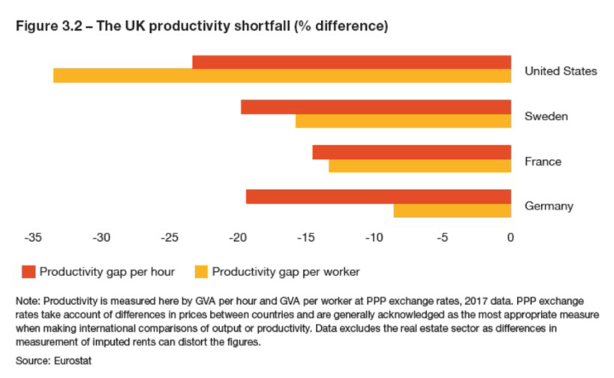
Figure 1 – Graph showing how much less productive the UK is than other developed economies
The productivity problem in the UK is a pressing issue that has significant implications for economic growth, living standards, and global competitiveness. Productivity, defined as the measure of output per unit of input (typically labour or capital), is crucial for evaluating how efficiently an economy converts resources into goods and services. Historically, the UK has struggled with productivity levels that lag behind those of other advanced economies, a situation often referred to as the “productivity puzzle.”
John Van Reenen, director of the Programme on Innovation and Diffusion (POID), succinctly captures this crisis: “The UK productivity problem can be summed up in three words: investment, investment, and investment. Or lack thereof.” This lack of investment underpins the productivity stagnation, as it limits businesses’ capacity to innovate, expand, and improve efficiency.
As illustrated in recent data, the UK’s productivity is significantly lower than that of its peers, underscoring the urgency for strategic intervention. This article proposes a range of targeted strategies aimed at enhancing productivity in the UK, focusing on critical areas such as workplace training, pension fund reform, planning reform, and tax reform. By addressing these interconnected factors, the UK can create a more conducive environment for investment and drive sustainable economic growth.
WORKPLACE TRAINING, MANAGEMENT & FURTHER EDUCATION
A significant issue that hinders the UK’s productivity is a skills mismatch. A lack of high-skilled jobs in the UK, or those which are not aligned to workers’ skills, demotivates them due to reduced pay and hindered career progression, with over-skilled workers nearly twice as likely to leave a job than those well-suited. Furthermore, a quarter of employees reported that they had not received training in the last year, leading to similar effects.
To address this, organisations should conduct a skills audit to identify and make better use of their people’s skills. A review of job design and team structures will develop employee empowerment and greater trust, leading to increased worker productivity. Thirdly, recruitment practices need to avoid using degree-level qualifications as a filter and focus on those well-suited and adaptable. Transferable skills, (e.g. customer interaction and basic numerical and digital skills), need to be formally taught to boost efficiency and upskill the whole labour force, boosting productivity as shown below.
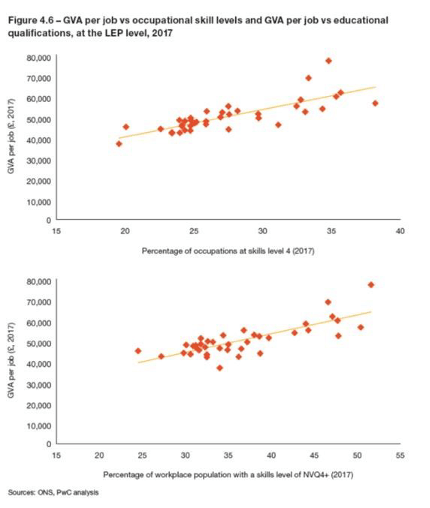
Figure 2 – PwC graph showing strong positive correlation between skill levels and increased productivity
Around 11% of UK firms are as well-managed as the top 25% of American firms, so training programs are needed to prepare line managers to fulfil their roles because they oversee development opportunities of junior colleagues.
With seven million predicted to be under-skilled, primarily in the digital space, Further Education reform should focus on providing the relevant skills for improved worker competency. Faster action is required as the proposed Advanced British Standard that promises this will take ten years to roll out fully and longer for the benefits to be realised.
PENSION FUNDS REFORM
The UK has low domestic investment from Pension Funds and a fragmented ownership base. Rebuilding concentrated firm ownership could allow for more pension scheme funding available for business investment.
The government should increase the amount of defined benefit pension assets invested in a similar fashion to the UK Pension Protection Fund (PPF) which retains more exposure to risky assets. By creating regulations around superfunds, the funds’ generated revenues can be shared fairly with its members. The remit of the PPF should be expanded so that it acts as a state consolidation option for solvent pension schemes, providing trustees buyout certainty and making them likely to invest.
The consolidation of defined contribution schemes needs to speed up, to allow more concentrated active ownership of UK firms, making them larger so more active investment can take place. Stringent value for-money tests and regulations should be implemented to ensure that non-compliant funds transfer their assets to multi-employer DC pension trusts or other authorised master trusts.
PLANNING REFORM
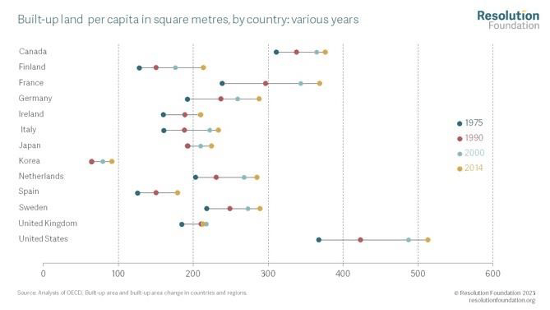
Figure 3 – Resolution Foundation graph showing lack of infrastructure development in the UK over the past three decades
Investment is impeded by the UK’s inefficient planning system. In innovative hot spots such as Oxford, listed buildings and countryside pose restrictions and house prices are driven up, deterring potential high-skilled employees from relocating.
The Local Planning Act 2023 proposes to expedite the authorisation process so examinations last under six months and gives local communities a voice in two consultation rounds. These reforms provide certainty and speed with development so businesses are not discouraged from expanding.
TAX REFORM
The UK has one of the least certain tax environments in the world discouraging businesses from making risky investment decisions.

The tax reform outlined above could bring more physical investment, a more dynamic commercial property market, more SME growth, and more formal employment. The key reforms are discussed below.
Currently, those who receive the child tax benefit face high marginal tax rates up to 70%, hindering productivity as workers seek to reduce their income by reducing hours and declining promotions. Thus, the Child Benefit and Personal Allowance Withdrawal schemes should be scrapped.
Many businesses stay below the VAT threshold due to the administrative and financial burdens. A smoothing mechanism that extends the accounting and registering period to six to nine months could alleviate this. Relief for businesses on their first VAT bills, which decreases over time, could also help. Approaches such as low Nordic or high Singaporean thresholds could
respectively force businesses to grow or give them more leeway to. However, the latter could be economically too costly, and the former could create too much pressure on businesses in an already volatile climate.
The UK has a high rate of stamp duty for residential property and a complicated tax structure, making moving too costly. LSE researchers found that it also decreases the mobility of labour to better employment. This reduction in up-flow and down-flow transactions leads to connected businesses suffering from a lack of demand. Reducing moving costs from the highest to the median level in the OECD could lead to a 7% reduction in the skills mismatch and a 2.5% increase in labour productivity. Thus, stamp duty rates for main homes should be halved.
CONCLUSION:
An initial consideration included investing in transport to alleviate regional disparities but this has long proven to be costly, as seen with HS2 – however, focusing on intra-regional links would bring an extra £2.5-£4.5bn in productivity compared to inter-regional travel. Investing in struggling industries such as manufacturing or telecommunications or boosting productive industries with a focus on supply chain issues and R&D programs could boost productivity but is harder to predict. However, both pension fund and tax reform are quickly achievable and can unlock a lot of investment that can be diverted to sectoral improvements, which is very effective in the short-term. Akin to planning reform it also makes the UK a more enticing business environment. Improving skills is also more achievable within the workplace, but extending this to Further Education is currently being drawn out. Changes to the national curriculum should be introduced to help younger people prepare for the digital world. In the long-term all discussed strategies should boost UK productivity, through investing in workplace skills and intra-regional transport being more effective on a national scale for underperforming regions.
FIGURES:
F4

PISA rankings 2022, showing the UK has high levels of tertiary education, thus the issue lies elsewhere, Source OECD
F5
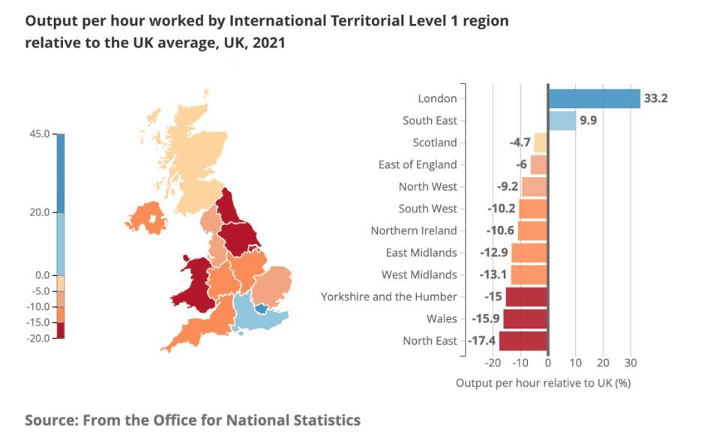
Graph showing disparities in productivity across UK
F6
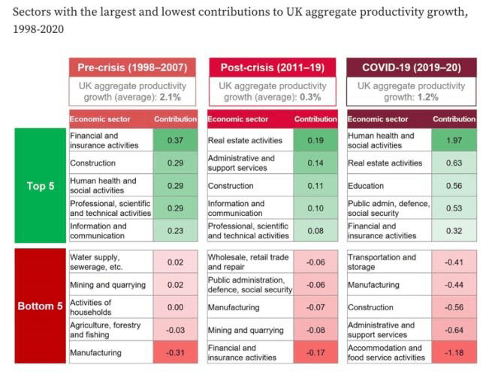
This graph shows that the manufacturing industry had long dragged productivity behind, Source Cambridge Industrial Innovation Policy
F7
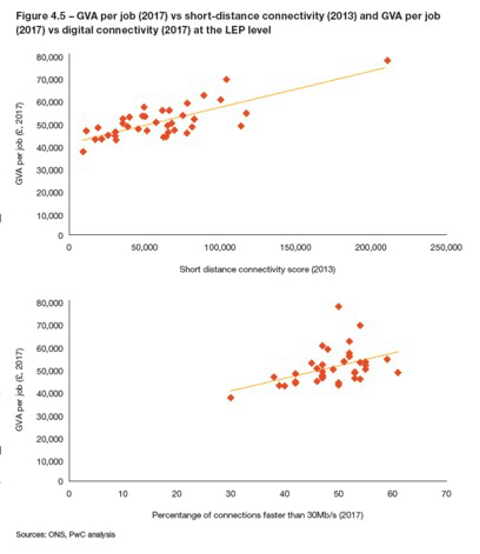
In the graph above, a 1% increase in the short-distance connectivity score boosts productivity by 0.06%. If Cornwall improved its short distance connectivity score to match the Heart of the Southwest LEP (an increase of 85%), its productivity would increase by around 10%.
 etonomics.com