
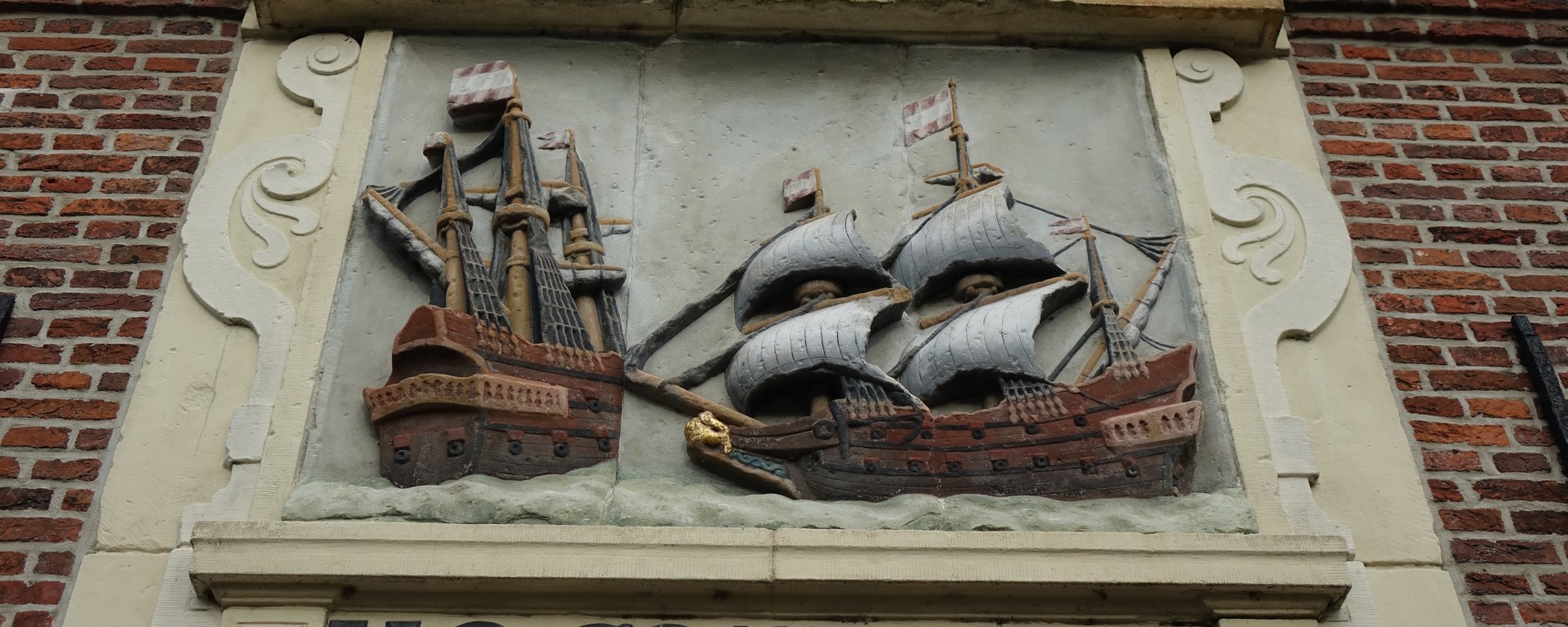
During the early 17th century, the Dutch found themselves in increasingly competitive waters concerning their early dominance of maritime trade. The English, Portuguese and Spanish were all threats to the diminishing share of the Netherlands in the lucrative spice trade. Something had to be done. Yet how would a single organisation gather the huge amounts of capital required for such an undertaking? Creating a corporation may seem like an obvious choice nowadays, but in the 1600s, such an idea was completely revolutionary.
Currently, the structure of a corporate, publicly traded company is widespread globally, allowing everybody – from business moguls to construction workers – to contribute to businesses, trade shares, and, hold assets. Such concepts may seem novel and modern, associated with gilet-wearing ‘finance bros’, but it was really during the early 17th century when tights-wearing, breach-sporting Dutch merchants and politicians, through the creation of the Dutch East India company, set the precedent that modern companies now follow. From shareholder rights to plebian involvement, the Dutch East India company, or the Vereenigde Oostindische Compagnie (VOC) is still fascinatingly influential to modern economics.
To effectively counter the threats to their trade, especially from the Spanish, the Dutch Republic recognised the urgent need for financial resources and infrastructure. This pivotal moment led to the establishment of the United East India Company, commonly known as the Dutch East India Company (VOC). Before the company was established, a few groups of merchants had set up temporary enterprises, known as ‘precompanies’, to trade with the Far East. Expeditions were costly and extremely dangerous. The VOC was officially incorporated on March 20, 1602, being granted a monopoly by a charter issued by the States General (the highest administrative body in the Dutch Republic) These articles gave the company huge powers – such as exclusive trading rights, the ability to sign treaties, establish colonies and even wage wars – all in an effort to scramble trading influence from other European powers. However, it was the tenth article of this charter that would arguably become the most novel: the article allowed the general public to buy into the company as shareholders.
The corporation’s structure was unique at the time: the Dutch East India Company was arguably the world’s first publicly-traded Company. On 31 August 1602, a total of 1,143 investors raised 3.7 million guilders (around $350 million dollars) of share capital for the initial Amsterdam Chamber. While the Dutch celebrated their revolutionary system, it was clear that such a crude structure was problematic: when the pre-companies were merged into the VOC in 1602, there was no change in the absence of shareholder control rights. However, the newly established, much larger VOC often faced more long-term challenges than the pre-companies it was made up of. The failure to adapt the control structure to suit the changing circumstances likely contributed to ongoing conflicts between the directors and shareholders from 1602 to 1623, and in 1622, upon the extension of the 1602 Charter, a significant conflict erupted between the two parties. The dissenting participants complained about the numerous conflicts of interest arising between the various directors and the VOC. They accused the directors of abusing power, short-selling, and self-enrichment, arguing that shareholder approval was necessary for the VOC to borrow funds from the capital market and that large investors should be entitled to vote on the appointment of new directors. Drawing parallels with the English East India Company, which was run by a board of directors, the dissenting participants advocated for a similar corporate governance for the VOC.
To mobilise public opinion and convince merchants not to invest in the Dutch WEST India Company, which was also being incorporated into the VOC at the time, the shareholders published their complaints in pamphlets. They also exerted pressure on the government to ensure that more rights were granted to shareholders when the VOC Charter was extended. This is the first example of shareholder activism. To some extent, their protests were successful: the subsequent 1623 Charter granted certain rights to large investors, including the right to nominate new candidates for appointment as directors. It also regulated insider trading by the directors and encouraged them to pay a yearly dividend to the shareholders. Additionally, a committee of nine shareholders was entrusted with supervising the VOC directors. This corporate body was known as the “Lords Nine” (Heren IX). Many of these principles devised in the 1623 Charter are still seen around the world today.
Other problems also needed ironing out. For example, directors and traders of precompanies were worried that Amsterdam would have an unfair advantage of trade because of the newly established VOC, leaving out other Dutch provinces. Thus, it was decided that the company’s chambers should be located in six Dutch cities: Enkhuizen, Hoorn, Delft, Rotterdam, Middelburg, and Amsterdam. All the directors of the precompanies that were still in business also became directors of the relevant VOC branches so that all shareholders were satisfied.
The VOC was, however, still an expensive and risky investment for many shareholders: it took the company around ten years to send its first ships onto the sea. Consequently, in order to make investment more approachable, the VOC made it evident that the transfer of shares was feasible and could be accomplished through the bookkeeper of the relevant chamber. On March 3, 1603, Jan Allertsz tot Londen became the first shareholder to dispose of his subscription, valued at 2,400 guilders to Maria van Egmont, with an additional 600 guilders to Mrs. van Barssum. Although Allertsz was not entitled to any profits derived from the trade with the East Indies (which is equivalent to modern dividends), he would profit from his initial investment with the company since the price of the shares increased during the interim. This rise in share prices was attributed to the growing interest among the general public to purchase stakes in the VOC and the diminishing supply of shares available, clearly showing the contemporary success of the company.
Successes did not stop here; the VOC soon grew immensely in power and size, and is now widely regarded as the wealthiest enterprise in history: According to Business Insider, the VOC’s value in today’s currency would amount to approximately $7.9 trillion, equivalent to the combined GDP of Germany, the United Kingdom, and Spain.
The Dutch East India Company, a commercial powerhouse for nearly two centuries, was established with both commercial and political motives: The Dutch believed that expelling the Spaniards from the lucrative Asian market would free up funds to finance the 80 Years War between Spain and the Netherlands. However, over time, the company’s power waned, leading to bankruptcy due to corruption and crippling debt. Eventually, in 1799 the Dutch Government revoked the company’s charter and took over its debts and possessions. Despite its demise, the establishment of the Dutch East India Company positioned the Dutch Republic as a global trade leader and propelled it to economic superpower status. Today, the Netherlands would be vastly different without the legacy of the VOC.
 etonomics.com