

News Briefing – 05/03/2025
World Politics World Economics UK Politics UK Economics: Continue reading News Briefing – 05/03/2025
World Politics World Economics UK Politics UK Economics: Continue reading News Briefing – 05/03/2025
World Economics: The International Monetary Fund (IMF) has issued a warning that increased global protectionism and tariff hikes will threaten world economic growth, highlighting that if tariffs hit a ‘sizeable swath’ of world trade by mid-2025, it would wipe 0.8% from economic output in 2025 and 1.3% in 2026. IMF’s top economist Pierre-Olivier Gourinchas has argued that increased tariffs are ‘harming basically everyone…including the US.’ … Continue reading News Briefing – 25/02/2025

An Introduction to Catastrophe Bonds and the L3C Catastrophe bonds (or cat bonds) are high-yield debt instruments used to raise money for companies in the insurance industry in the event of a natural disaster. A bond is a financial instrument in which the issuer (a government or company) sells bonds to investors, which gives the issuer capital, raising money. They pay the investor with regular … Continue reading Catastrophe Bonds

‘We need Greenland for national security purposes,’ declared President Donald Trump in a press conference on January 7th, a move shrouded in controversy that angered the EU, Denmark, and other rivals such as China and Russia. A closer look shows that his goal is much bigger than just spending almost $70 billion to buy a huge, mostly empty hunk of ice. Firstly, this was … Continue reading What is Trump’s Obsession with Greenland?

The world of professional golf has witnessed a seismic shift in recent years, marked by the emergence of LIV Golf—a breakaway professional golf league funded by Saudi Arabia’s Public Investment Fund (PIF). Initially called the ‘Premier Golf League’ in 2021, the name was later changed to LIV, 54 in Roman Numerals, signifying the number of holes played at each tournament: a shorter, seemingly easier to … Continue reading LIV Golf

Sports. We all love them – whether we are watching them, playing them or shouting at the TV like we can do any better. While most of us focus on the action itself, we often ignore the huge economic impact it has on the world. Obviously, the players are well compensated, with the ten highest-paid athletes in 2024 raking in a cumulative 1.38 billion USD. … Continue reading The Economics of Sport

Alternative für Deutschland (AfD) is a far-right party driven by euro-scepticism and anti-immigration; the party is now radically shifting Germany’s political state. AfD has recently grown in popularity, catalysed by a combination of public dissatisfaction with the current political system, and endorsements from high-profile figures such as Elon Musk, who called out the party as Germany’s “last spark of hope”. As the country faces economic stagnation … Continue reading Germany’s Far-Right

Introduction: In classical economics, individuals are assumed to be rational decision-makers. Rationality in this case means making choices that result in an optimal level of benefit or utility to the individual making the choice. This view, which is known as ‘homo economicus’, or the economic man, is the portrayal of humans as agents who are consistently rational and narrowly self-interested, and who pursue their ‘subjectively … Continue reading Nudges – A Dive into Behavioural Economics

Nvidia’s share price (NVDA) during a five-day period up to January 28th Source: Google Finance, 2025 On Monday 27th of January, Nvidia (NVDA) suffered a 17% fall in its shares, constituting a $592.7 billion drop in market capitalisation – the total value of company shares held by investors – from $3.5 trillion to $2.9 trillion and corresponding to a fall in share price from $142.62 to … Continue reading Chart of the Month: January 2025
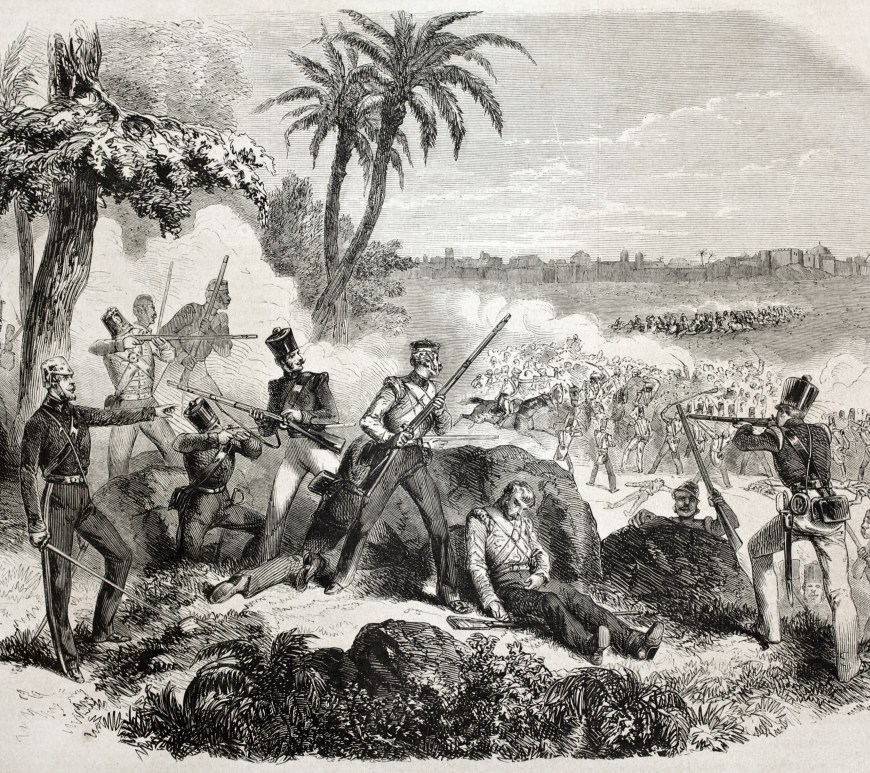
At its peak, the English East India Company (EIC) was not only the first multinational company of its day, but was also the largest corporation of its kind: the EIC surpassed the scale and power of many nations, effectively becoming the governing authority of India, one of the most economically productive regions of the era. Furthermore, even though the East India Company’s monopoly on trade waned in … Continue reading Corporate Colonialism

 etonomics.com