
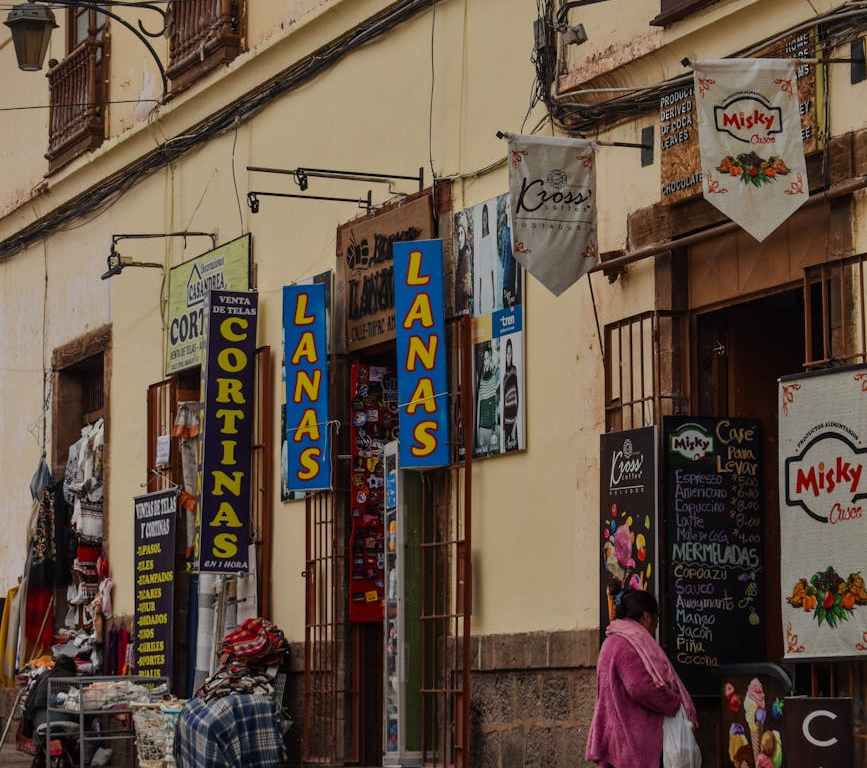
Across the streets of Lima, informal vendors, unregistered taxi drivers and cash-based micro-businesses form a familiar part of everyday life. Their presence illustrates a wider pattern: 68-72% of Peru’s labour force operates outside the formal economy. The informal economy can be defined as a set of economic activities carried out by workers and productive units that do not comply with the regulations established by the state. Despite sustained economic growth in the 2000s and relative macroeconomic stability, Peru has made limited progress in reducing this figure. The scale and persistence of informality now pose a structural constraint on the country’s development prospects.
Causes of informality
Peru’s high level of informality is the product of several intertwined economic and institutional factors. One of the clearest is the cost of formalisation for small businesses. Registration requires navigating multiple procedures, meeting compliance obligations, like bookkeeping, inspections and receipts, and absorbing payroll charges. For micro-enterprises that operate with uncertain revenues, these costs function as a significant deterrent. Remaining informal often appears financially rational even though it restricts access to credit, limits opportunities for expansion and prevents firms from benefitting from legal protections.
These barriers are reinforced by weaknesses in enforcement. Regulation is uneven across the country, particularly in rural and peri-urban regions where state presence is limited. Only 20,000 companies per year (Inter-American Development Bank) are inspected, and of that number, almost none of them are informal businesses. When inspections are so unlikely, and contract enforcement is slow and costly, there is little incentive to operate within the formal legal framework. Informality becomes a low-risk, practical arrangement rather than a temporary response to hardship.
The structure of Peru’s labour market also plays a central role. A large share of the workforce has limited access to high-quality education and vocational training: only around 35-40% (INEI) of the labour force has an education level higher than high school, and many workers also lack the skills required for higher-productivity formal employment. This has created a dual labour market: a relatively small formal sector offering higher wages and protections, and a much larger informal sector dominated by low-productivity, low-income work. Moving between the two can be difficult, particularly for older workers or those living far from major economic centres. Geography especially makes these difficulties more pronounced. Peru’s population is concentrated along the coast, leaving many Andean and Amazonian communities isolated and stuck with weak infrastructure and limited public services. In these areas, the state’s capacity to regulate economic activity is limited and informal work is often the default mode of survival.
The Andes and Amazon (pale yellow area) account for much of Peru’s territory and remain highly inaccessible, limiting state presence and infrastructure (World Atlas).
The consequences of informality
The consequences of such widespread informality are visible throughout the economy; Peru’s productivity grows only 1.2% per year. Productive growth is constrained because most informal businesses are small, often family-run and operating with minimal capital investment. Without financial records or collateral, they struggle to secure formal credit, limiting any potential for innovation or expansion. When the majority of workers are employed in such settings, national productivity inevitably grows more slowly.
Fiscal capacity is also weakened. Informal workers and firms do not contribute income taxes, VAT or social-security payments, leading to relatively low government revenue compared with many middle-income economies: accordingly, Peru’s tax revenue is 19.1% of its GDP compared to the average of Latin America, which is 21.5%. This restricts the state’s ability to invest in infrastructure, education and healthcare – all essential components of long-run economic development. This leads to the emergence of a self-reinforcing loop: low government revenue limits public investment, which constrains growth of the formal sector as there are less benefits available for formal businesses; this keeps informality high.
The social implications are also significant. Informal workers usually lack access to unemployment insurance, pensions and reliable healthcare coverage. Their incomes tend to fluctuate sharply during economic downturns, and they have few financial buffers. Without social protection, households remain vulnerable to sudden shocks, making it harder to accumulate savings or invest in education. This increases the risk of becoming trapped in low-income conditions.
Competition between informal and formal businesses further reinforces these challenges: Informal firms avoid regulatory costs and taxes, enabling them to offer lower prices. While this may benefit consumers in the short term, it can discourage investment by formal firms, which face higher operating costs but must compete for the same consumers. Over time, this weakens the modern sector of the economy and slows the process of structural transformation that could provide workers with financial buffers.
Attempts to reduce informality within Peru
Peru has introduced various reforms aimed at reducing informality, though the results have been mixed. Efforts to simplify business registration have reduced some administrative barriers. Digital platforms were designed to streamline the process (e.g. the Tu Empresa program, which was a formalisation scheme.) However, uptake remains uneven, especially in rural regions. Simplified tax regimes for micro-enterprises offer lower rates to those willing to register, but many firms still choose to remain informal because the ongoing obligations are perceived as too burdensome. Attempts to introduce more flexible labour regulations have encountered political resistance, reflecting concerns about job security and wage conditions.
How can informality be addressed in the future?
Addressing informality on a meaningful scale will likely require a coordinated strategy rather than isolated measures. This could include:
- Simplifying tax codes, reducing payroll burdens for small firms, and expanding access to credit for registered businesses would help shift incentives toward formal participation.
- Improving education and skills provision- by raising worker productivity, more individuals would meet the requirements needed to access formal employment.
- Investing in digital systems- electronic receipts and online tax filing can reduce compliance costs and increase transparency.
- Strengthening infrastructure in rural areas, which would help integrate isolated communities into national markets. This would make formal economic participation more feasible and less costly.
Conclusion
Peru’s informal economy is not simply a statistical anomaly but a central structural challenge. Its scale constrains productivity, reduces the state’s capacity to invest and leaves millions of workers vulnerable to economic shocks. Moving toward a more inclusive and resilient growth model will require policies that address not only the administrative barriers to formalisation but also the deeper institutional and social foundations that sustain informality. The problem is deeply rooted, but the costs of inaction – lower growth, weaker public services and persistent vulnerability – are increasingly clear. Therefore, tackling informality is not merely a technical economic challenge but a moral and strategic imperative. While gradual reforms are valuable, Peru needs a bold, integrated approach that combines regulatory simplification, investment in human capital, and infrastructure development. Without such decisive action, the country risks perpetuating a cycle of low productivity, weak fiscal capacity, and social vulnerability, ultimately limiting the benefits of its economic growth for the majority of its population.

