Are Stock Market Indices effective in Predicting Economic Trends?

Stock Market Indices, commonly referred to as the barometers of the financial world, have long been utilized by investors and economists, who believe that their movements can provide insight into the broader economy. These indices such as S&P 500, Dow Jones Industrial Average (DJIA) and NASDAQ Composite are widely considered as the key indicators of overall market performance and can be seen as valuable tools … Continue reading Are Stock Market Indices effective in Predicting Economic Trends?

Cryptocurrencies and CBDCs – The Future of Money

As the world rapidly adapts to huge technological advancements, the traditional way of handling money has completely transformed. The rise of cryptocurrencies and development of CBDCs (Central bank digital currencies) have sparked a financial revolution, shaping the future of financial systems worldwide. Cryptocurrencies are completely digital and can be used as an alternative form of payment. They are created using encryption algorithms that ensure their … Continue reading Cryptocurrencies and CBDCs – The Future of Money

Boom to Bust: The Implications of China’s Real-Estate Crisis

Overview China’s economic boom over the last three decades has been well documented; its gross domestic product (GDP) grew at an average rate of 9% annually between 1989 and 2022 and is forecasted to overtake the American economy by 2035 according to Goldman Sachs. But economists frequently overlook a major vulnerability of the Chinese economy: its fragile real-estate industry. For decades, China’s economy has been … Continue reading Boom to Bust: The Implications of China’s Real-Estate Crisis

Black Wednesday 1992: Lessons in Disaster 

In the weeks following Wednesday 16 September 1992, the Pound crashed 25% against the US Dollar. Dubbed ‘Black Wednesday’ or the ‘Sterling Crisis’, the chaotic events of that day would have a lasting impact on Britain’s economy, politics and relationship with Europe. But despite this fact, the causes and effects of the 1992 Sterling Crisis are still not widely understood among the general public today.  … Continue reading Black Wednesday 1992: Lessons in Disaster 

What MMT Can Do For Us

Initially written in response to question:  A government funds its own expenditure by taxing its population. Suppose, instead, it relied solely on money newly created by the central bank? What would be the advantages and/or disadvantages?    The notion that governments rely on the tax revenues derived from individuals and businesses and thus cannot simply “print more money” to solve any issues they might face … Continue reading What MMT Can Do For Us

The Euro’s Fundamental Problems

To conduct international trade and financial transactions, a reserve currency is necessary to eliminate the costs of settling transactions, involving different currencies. Prior to reserve currencies, the gold standard was used to align all currencies, but Gold did not grow at a pace with the real economy and caused crashes as a result. The financial economy has to grow faster than the real economy, otherwise … Continue reading The Euro’s Fundamental Problems

The Asian Financial Crisis

The 1997 Asian financial crisis was one of the most devastating economic periods since records began, gripping Southeast Asia for most of the late 1990s.  Originating in Thailand in July 1997, this crisis rapidly spread to many other countries with a ripple effect, demonstrating the impact of financial contagion. Nicknamed the Tom Yam Kung crisis (a hot and sour shrimp soup which is seen as representative … Continue reading The Asian Financial Crisis

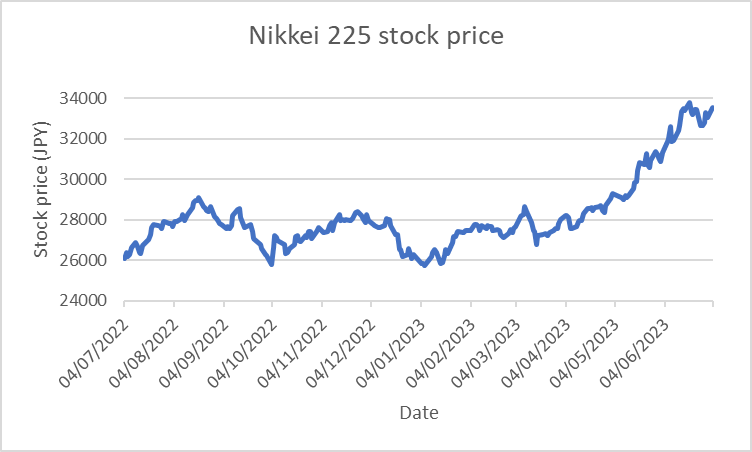
Chart of the Month – July 2023

July’s chart of the month shows how Japanese stocks have performed since COVID. In 2023 alone, the Nikkei 225 has grown by 30%, triple that of the S&P 500, and far exceeding the growth of most European indexes. The Nikkei is now only 20% off its peak in 1990, growing 6% in June. Investors must ask: have Japanese stocks at last recovered from a 30-year … Continue reading Chart of the Month – July 2023

Calm Before the Storm: Falling House Prices in the UK

House Prices are Falling The UK’s current housing market might shock much of the British population, as high interest rates have led to house prices being down 3% nominally and 11% accounting for inflation since their peak in August 2022. (Bloomberg UK, 2023) However, this surprise is understandable as UK house prices have been a one-way bet for a long time, consistently rising since 2012, … Continue reading Calm Before the Storm: Falling House Prices in the UK

The Great Financial Crisis

Before COVID, the Great Financial Crisis (GFC) of 2008 was the most severe economic downturn since the Great Depression of the 1930s. Also known as the Global Financial Crisis, the GFC caused a nationwide recession, as well as causing global trade to decrease by 15% between 2008-2009. Nearly every country in the world was affected by the decline of economic growth, the loss of jobs, … Continue reading The Great Financial Crisis