
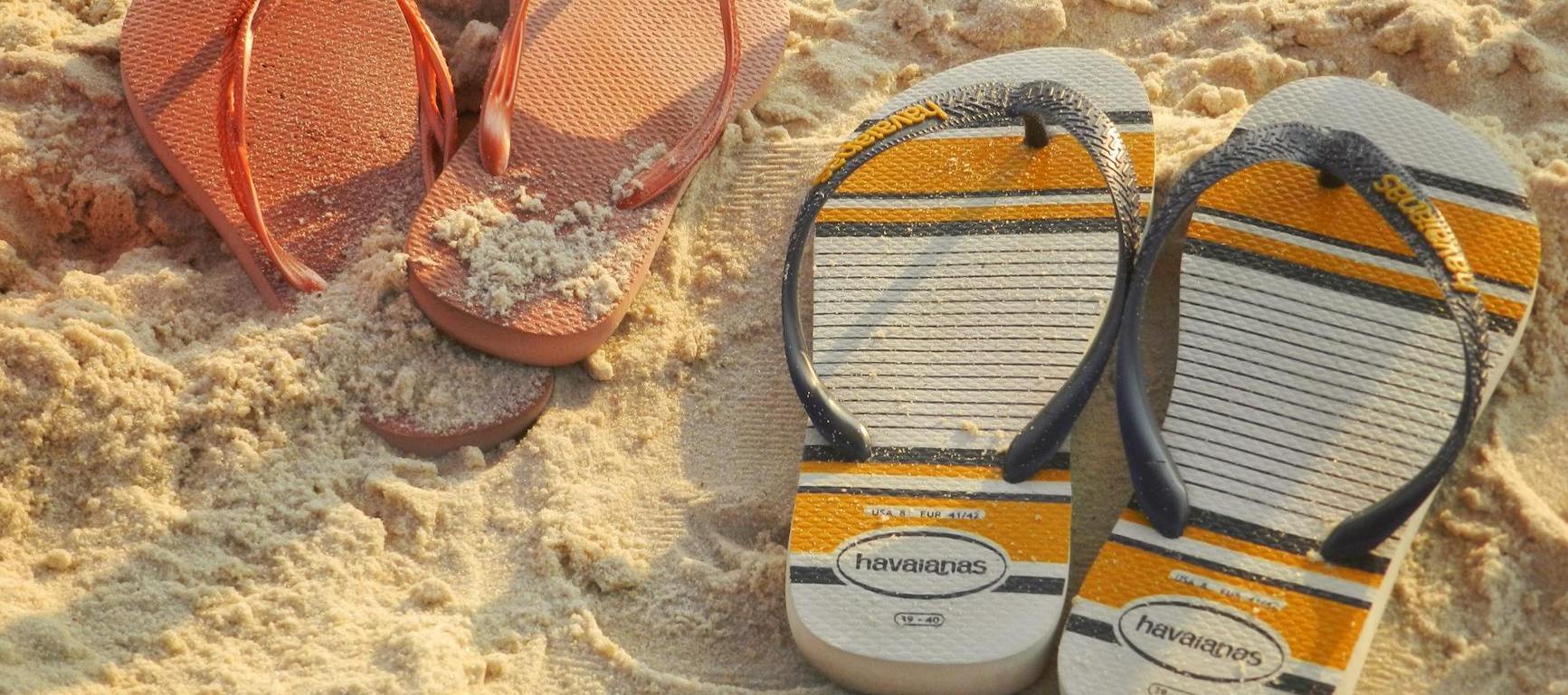
Havaianas is a Brazilian flip-flop brand, owned by Alpargatas S.A. – a Brazilian textiles manufacturer. As most people will know, Havaianas manufacture the world’s most popular rubber soled sandal, which has been worn from sandy beaches to fashion show runways. What is particularly fascinating about Havaianas is the extent to which it embodies Brazilian national identity and a more carefree way of life that is very different from that of the UK and other western nations.
The Story of Havaianas
The rubber soled sandals that we know now as Havaianas were first designed in 1958 by Robert Fraser, inspired by traditional Japanese zori sandals, which were brought into Brazil by Japanese immigrants throughout the 20th century. The brand name “Havaianas” – meaning “Hawaiians” in Portuguese – was trademarked in 1962 and drew on the exotic allure of Hawaii at the time. For decades, Havaianas were regarded as a poor man’s shoe, worn mainly by Brazil’s working class who needed practical, comfortable and durable footwear.
Nonetheless, the brand was already a firm household name in Brazil by the mid 90s, with over 80 million pairs of Havaianas being sold every year. In the 90s, Alpargatas (its parent company) decided to attempt to reshape the image of Havaianas into a more desirable and fashionable product. They invested in design innovation, celebrity endorsements and new colourways which ultimately led to great success for the brand over the next decade. Notably, the small Brazil flag on the strap of many Havaianas flip flops originated from this decade, after Havaianas launched this new design alongside the 1998 World Cup, further cementing its national symbolism. A year later, in 1999, Havaianas appeared in a Jean Paul Gaultier runway fashion show, which granted their product lots of attention and signalled its newfound rise into fashion.
Although Havaianas dominated the flip flop and sandal market in Brazil by the mid 2000s, with a whopping 850 pairs of flip flops sold per 1000 people in 2007, they wanted to become globally successful. This meant needing to strategise correctly in order to achieve global success.
The Genius of Havaianas
Breaking into the global market seemed quite a challenge as most global products had originated in high income countries, for example, the USA or Western Europe, so there was no real precedent for a successful global fashion product coming from an emerging market.
However, the genius in Havaianas was keeping consistent to the product, focusing on new innovation and a clear marketing strategy. Over the following years, Havaianas created many different variations of the original sandals, with ankle straps, different colour ways, limited editions, sliders and even espadrilles. This meant that Havaianas stayed consistent to their product and did not dilute any of the brand’s essence, whilst catering to a wider group of customers from around the world.
In terms of their marketing campaigns, the brand collaborated with high-end fashion designers such as Valentino and Dolce&Gabbana, whilst also collaborating with Marvel and Disney. Thus, the brand managed to create a sense of fashion credibility and a sense of mass appeal simultaneously through these collaborations. In 2026, Havaianas have a very big social media presence that allows them to amplify their reach and promote their product to all the world in the very digestible and fun format of social media posts. Furthermore, in 2026, Havaianas has a product that completely transcends all social class boundaries in Brazil. What once was a working man’s shoe, has now become a national icon; something which is accessible by all and still proudly Brazilian.
Looking to the Future
Today, competition for footwear is extremely competitive, especially in lower cost and easy-to-produce products. The question for the future of Havaianas, therefore, is how they plan to stay relevant and desirable in a market that is increasingly being crowded by lower cost alternatives. So far, Havaianas has created new products, such as bags and clothing, that still keep to the image of the brand. Nonetheless, it will still be interesting to see how Havaianas will continue to evolve over the next few years, in order to maintain the popularity it has today.
Conclusion
Havaianas represent the fun and easy-going spirit of Brazil. The brand’s journey from a poor man’s shoe to global success, in some ways mirrors Brazil’s own history of resilience and creativity. Whether they are worn on Clapham Common, at a fashion show in Paris or Rio’s Copacabana beach, they will always carry a proud piece of Brazilian national identity and vibrancy.

