
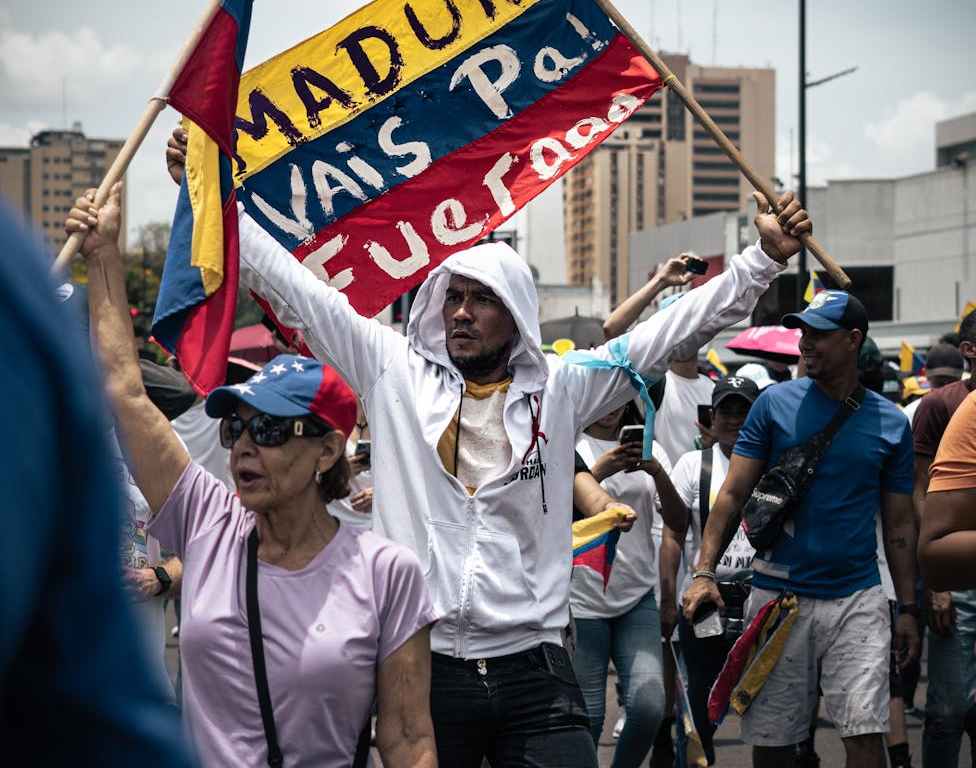
In recent years, Venezuela’s economy and living standards have taken a turn for the worse. It has faced record numbers of inflation, intense poverty and disparities of wealth, as well as plenty of corruption and protests. This may come as a surprise; Venezuela sits on the largest oil reserve in the world and has a plethora of rare ores such as gold and silver. How did Venezuela throw away the opportunity to be a country of wealth and prosperity?
Venezuela’s history
In the 1920s, the major oil reserves in Venezuela were discovered, causing major changes to its previously weak economy. From there, oil started to dominate the economy. At its peak, Venezuela was pumping out almost 4 million barrels of oil per day. It quickly became a Rentier State, earning most of its revenue from renting out its oil to foreign entities. The rent earned from this goes towards the government, which causes a very large injection into the circular flow. Since the Venezuelan government now had such a large sum of money, their fiscal surplus allowed them to decrease taxation and increase welfare schemes and spending on the public.
From this, living standards of Venezuelans greatly increased, leading to more happiness. In 2008, Venezuela was nominated as the happiest country by the World Values Survey: 55% of its population said that they were “very happy”, and also had a 7.4 / 10 Subjective Wellbeing Score (SWB). In contrast, the SWB in the UK in 2008 was 6.9 / 10.
However, Venezuela was heavily dependent on the oil market and its prices. With extremely low oil prices internationally in the 1970s, the country suffered extremely low GDP per capita (lowest reaching $1,015 (current USD) in 1970). However, when oil levels started to climb, Venezuela greatly profited, with its highest GDP per capita reaching nearly $16,000 in 2014. By 2014, oil was 95% of export earnings. In this way, Venezuela was able to launch itself from the low-income threshold (less than $1,135) into the high-income threshold (above $13,935) in under 45 years! This shows just how heavily the Venezuelan economy and its people relied on the exports of oil. With this, the dependency on other countries’ economies to perform well also arose: if the economy of a foreign country was suffering from a recession, the oil imports of this country would decrease, resulting in a decrease of oil exports in Venezuela. This would impact the economic performance of Venezuela greatly, and therefore also have an impact on its people (decreasing GDP per capita).
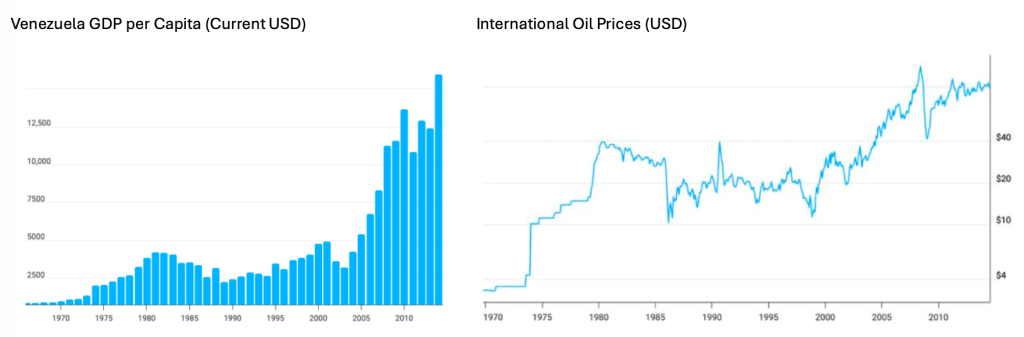
2014 was when Venezuela reached its highest GDP at $482bn. After this, Venezuela suffered a severe economic contraction due to a change in government and policy.
Hugo Chávez
Chávez was elected president in December 1998, taking office at the start of 1999. During his time, Venezuela saw its greatest GDP growth from $97.52bn to $372.59bn, and inflation remained stable at around 20% per year.
This, undoubtably, had been a result of climbing oil prices. From 1999 to 2001, Chávez leaned into this, establishing a social democracy – a left-leaning state in which there were many social programmes and welfare schemes – which overall improved the life of Venezuelans.
However, when oil prices began to stall in 2002, Venezuela experienced a contraction, and the country’s GDP fell to the same levels of 1997. The people suddenly had a change in heart towards Chávez, and in 2002, a coup d’état was attempted against him. Furthermore, a general strike from December 2002 to February 2003 took place due to rising discontent with Chávez and the state of the economy. This caused a halt mainly for the oil industry, causing Venezuela’s economy to plunge further into instability, and also exposing the scale of the reliance that Venezuela had on its oil industry.
Chávez’s health began to decline in 2012, ultimately causing him to step down from power. Although Chávez’s time in power wasn’t perfect, it did result in growth for the country, and in the end, the welfare and happiness of Venezuelans was greatly increased.
Nicolás Maduro
On the 14th April 2013, Nicolás Maduro was elected into power. His political stance and growing unpopularity started one of the greatest declines in economic history. Maduro was very keen on keeping Venezuela’s oil dependency, and instead of fixing the potential Dutch Disease (when a boom in one sector, oil, results in a fixation on that sector, ignoring potential economic growth in other sectors like agriculture and manufacturing), Maduro doubled down on it. Unfortunately for Maduro, oil prices in 2014 took a massive hit, falling from over $100 per barrel to just over $30 in the space of 18 months. This effectively pulled the rug out from under the country and created economic instability.
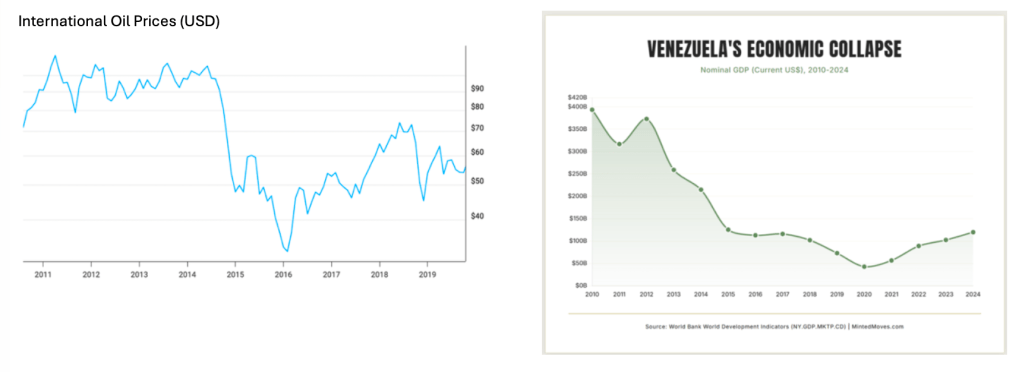
In 2014, Venezuela officially entered a recession with a GDP growth of -3%. From 2014 to 2020, Venezuela was stuck in this recession, with an increasingly large negative growth rate. In 2020, there was a GDP growth rate of -30% before Venezuela finally escaped the recession in 2021, according to World Bank Group.
However, during this time, Venezuela experienced the worst inflation in human history. As previously stated, under Chávez, the inflation rate remained at a stable 20%. However, as soon as the recession started, Maduro and his government started printing money to create their budget. At the same time, the production of goods began to fall (as the country was in a recession), meaning that there was more money for less goods, causing the general price level (the rate of inflation) to skyrocket. This, combined with the building lack of trust in the bolivar and corruption in markets (especially oil), caused increasing instability in the currency.
2013 signalled the start of the inflation crisis, with an inflation rate of around 45%. This continued to increase (in 2015 the IMF stated a figure of 159%) and became the world record for the highest rate of inflation recorded in Venezuela and in human history. Venezuela continued to break its own records: Bloomberg’s ‘Café con Leche Index’ (the average price of a cup of coffee) found that in just 12 weeks leading up to January 2018, the price level increased by 720%, and so a yearly rate of inflation was calculated to be 448,000%, by far the highest in history. Later that year, the National Assembly noted that the average price level doubled every 28 days, meaning that the annualized rate of inflation was around 25,000%.
The People
These devastating effects of Maduro’s time in power understandably caused a massive decrease in the welfare and living standards of the people. In fact, the country became such a terrible place to live that it caused what has come to be known as the “Venezuelan Refugee Crisis”. According to UNHCR, almost 8 million people have emigrated since Maduro came to power, which is over 20% of the previous population.
All the way from 2013-2020, Venezuela has been first in the Hank’s Misery Index, a system that calculates a country’s relative score by viewing the seasonal inflation rate and unemployment rate. This is obviously in direct contrast to Venezuela less than 10 years before the start of the recession, when it was elected the happiest country.
By 2015, Venezuelans lost so much faith in the currency that a black market was created just for exchanging the currency (Bolivars) into USD. This was due to the fact that ordinary Venezuelans were actually not allowed to legally exchange the Bolivars into other currencies due to the tight control by the government – if people were to all exchange Bolivars into dollars, it would only catalyse the depreciation of the Bolivar and thus increase the rate of inflation even further. For this reason, only government personnel were allowed to exchange the Bolivar legally.
What this meant was that when real wages in 2018 were 18,000 Bolivars a month (roughly $30), it was actually worth less due to the different exchange rate into USD in the black market. This would also happen as inflation started to rise, meaning that Venezuelans could not afford basic needs, and their standards of living plummeted.
The data given by the National Service on Living Conditions (ENCOVI) in 2019-2020 found that 96% of Venezuelans were poor, with 79% of the population living in extreme poverty, meaning they are unable to feed themselves. ENCOVI measures poverty not just by income, but also looking at education, housing conditions, and basic services for necessities (water, sanitation, cooking fuel, etc). Extreme poverty, defined by ENCOVI, is less than $1.90 a day or living in extreme deprivation of necessities.
Compare this to 2013, when it was estimated just 30% of the population was considered to be in poverty.
Moreover, there is an extremely high inequality of income in Venezuela: in 2024, a GINI coefficient (a number measuring the inequality in income, wealth, and consumption – the lower the number, the less the inequality) was 53.9, meaning that the GDP per capita of roughly $8,000 is actually less than that for most of the population.
Due to such a low-income population, Venezuela holds one of the ten lowest scores in the Global Food Security Index, with 78% of the population reporting that they had a constant fear of running out of food. By the end of 2025, it was estimated that 5.1 million people were expected to require urgent food assistance. The country has fallen into such despair that the UNHCR has declared Venezuela to be in a long-term humanitarian crisis.
Hope for the future?
The question the world faces today is will Venezuela bounce back? Venezuela most certainly has the potential. The oil reserves still stand as the largest in the world, and Venezuela hosts many valuable ores such as diamond, gold, and silver. This gives it a strange opportunity to begin anew, learning from its not-so-past mistakes.
On January 3rd, 2026, President Trump of the United States of America authorised the capture of President Maduro and his wife, Cellia Maduro. This brought a lot of controversy and outrage across the world, but the celebration of Venezuelans across the world silenced the complaints. For them, (although the ulterior motives of the USA are clear) this has the potential to signal the start of a new beginning, overthrowing the corrupt government and beginning to impose economic and political reforms to repair the broken country.
The USA imposed an acting president of Venezuela in the interim, Delcy Rodríguez. She was the vice president of Venezuela under Maduro since 2018 and was later appointed minister of economy and finance. She has also been sanctioned by many countries for her part in the collapse of Venezuela, and was banned from entering Columbia. This can tell the public a lot about what she believes and who she is: a follower of Maduro may be hesitant to fix the country at the possible expense of her comfortable position (unlike the general population).
However, with US pressure, and seemingly US backing, she may have her hand forced. Oil production has already started to increase, hopefully signifying the reparation of the country.
But who knows what the future holds for this country? Only time will tell.
For further reading:
https://alianza.shorthandstories.com/the-face-of-poverty/index.html
https://en.wikipedia.org/wiki/Venezuelan_refugee_crisis
https://en.wikipedia.org/wiki/Misery_index_(economics)#
https://en.wikipedia.org/wiki/Economy_of_Venezuela#2013%E2%80%932020
https://en.wikipedia.org/wiki/Delcy_Rodr%C3%ADguez#Minister_of_Economy_and_Finance

