

Introduction
The Malthusian Model was proposed by Thomas Malthus in 1798 in his book ‘An essay on
the Principle of Population’, with the goal of showing the dangers of excessive population
growth in a pre-industrial world, where the majority of economic activity was produced by
the agricultural sector. While this model may have been relevant in pre-industrial England,
due to the huge technological development which has occurred in the past 230 years, does
this model still have a role today?
The Malthusian Model
The Malthusian Model assumes that economic activity is a result of two factors: capital
stock, and labour supply. This is represented in the production function of the model:

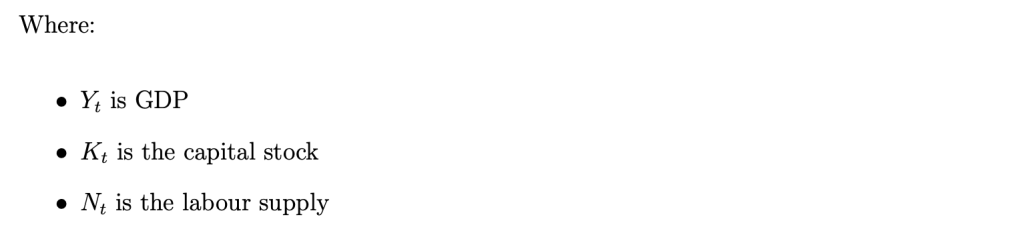
However, in 18th century England, the main, and almost only source of capital, excluding
human capital which is already accounted for, was land, whose supply cannot be increased or
decreased, and so is treated by the model as a constant. Therefore, the production function
becomes:

This implies that the labour supply is the only factor affecting the economy’s output. The
model also makes the assumption that population grows exponentially, while the food supply
only grows linearly. Therefore, there will eventually be a point where the population is too
great for the food supply to be able to support it, resulting in a crisis such as war or famine
as a result of resource scarcity. This point is called a Malthusian Crisis. This food scarcity
then reduces the population, and the economy reaches an equilibrium point where the food
supply is just sufficient to support the population.
This point is represented in the graph:
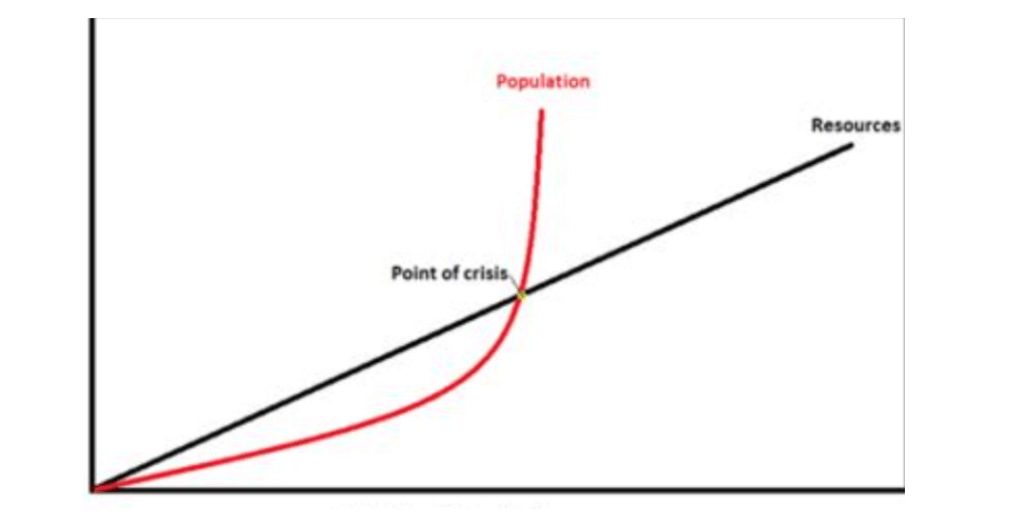
An economy, if it is at a stage where it is to the left of the point of crisis, will continue to
grow until it reaches that point. However, if the economy moves to the right of the point
of crisis, a Malthusian crisis will occur, and the population and food supply will lower, and
return to being to the left of the point of crisis, until an equilibrium point, where population
and food supply are even, is reached.
Critiques
While the model may have effectively portrayed the pre-industrial English economy, as it
was almost solely driven by agricultural activity, even in the decades following the model’s
development, it was inaccurate as it failed to account for the industrial revolution, and
the resulting increases in economic activity. One of the most significant impacts of the
industrial revolution in making the model inaccurate was that it meant that the capital
supply was no longer fixed. As the only source of capital was no longer land, but also
machinery – one of the critical assumptions of the model was now incorrect. Moreover,
the technological development caused by the industrial revolution also undermined Malthus’
theory as technological development also results in growth due to increased productivity.
The theory also makes the assumption that as an economy develops, its birth rate increases,
which was likely the case at the time, and a logical assumption as if there are more people,
and the proportion of people having children is equal, the population growth rate will be
higher; however, as data reveals, modern societies tend to have lower birth rates as their
economies develop.
Many modern economists also argue that the Malthusian model is overly pessimistic, and
underestimates the adaptive power of human society. Unlike Malthus’ assumption that population growth will always outpace resource growth, contemporary growth theory emphasizes the role of human capital, innovation, and institutions in expanding productive capacity. An example of this development is the Green Revolution in the mid 1900s which dramatically increased crop yields through new agricultural techniques, which the Malthusian model does not take into account. Moreover, more modern endogenous growth models (where the parameters are not fixed but decided within the model) incorporate technological progress as a key drive of economic output, and increase returns to scale over time – something which
Malthus disregarded. These more modern models highlight how investment in education,
research, and innovation can cause productivity to grow faster than the population, breaking
the assumptions of the Malthusian model.
Additionally, markets and price mechanisms play a crucial role in mediation scarcity. Rising prices for scarce resources incentivize conservation, innovation, and substitution. For
instance, when copper’s price rose in the early 20th century, industries increasingly turned
to aluminium and other metals to continue functioning, rather than continuing to rely on
copper.
Overall, the Malthusian model is an overly simplified model for economic growth, which
may have held some accuracy in the pre-industrial world, where the main driver of economic
activity was agriculture, and where technological progress was slow; however, now, where
technological progress is rapid, for example with the development of AI, and there are many drivers of economic growth, the model is largely unreliable.
Is the model still relevant today?
Despite its flaws, some argue that principles of the Malthusian model still apply in a modified
form, especially in the contexts of climate change, resource depletion, and inequality. As
global temperatures rise, agricultural yields may decline in vulnerable regions, where the
agricultural sector continues to be the main driver of economic activity, so the Malthusian
model is very applicable, and so a small Malthusian crisis as a result of declining agricultural
activity may occur. Similarly, water shortages, deforestation, and soil degradation in similar
regions also pose a real threat to economic activity, and could again result in a Malthusian
crisis. Finally, many neo-Malthusians have warned that the earth has a finite carrying
capacity, and can only yield so much food, and so unchecked population growth can still
lead to ecological collapse, and in extreme scenarios, to a global Malthusian Crisis due to a
lack of food.
In many ways, the model is still relevant today. As mentioned, in certain developing regions where the main driver of economic activity is the agricultural sector, many Malthusian
principles continue to apply. The idea of resource limitations also remains useful in sustainability discussions and long term planetary planning. Moreover, the model serves as a
foundational tool to understand economic growth at a basic level. However, the model in
almost every economy does not apply. Globally, technological advancement has outpaced
population growth, meaning economic activity will increase faster that population growth,
and GDP per capita will continue to grow. Food production per capita, despite the immense
population growth has increased dramatically over the past century, and population growth
in most parts of the world, and so economic models must reflect demographic complexity
and human adaptability. Moreover, the model offers an oversimplified version of economies,
assuming many exogenous parameters, such as technological advancements, and structural
complexities of economies, meaning that while the model may be a useful tool to understand
growth mechanisms, it cannot be used to predict future growth.
Conclusion
While the Malthusian model may have held some reliability in the 18th century, it is now
outdated and not an accurate description of global economics; however, its principles provide
a warning of what may occur in regions where food supply is insufficient for the population.
It reminds us that resource constraints are real, especially when innovation, governance, and
distribution mechanisms fail.

