
In 1776, Adam Smith took his readers inside a pin factory. One worker on his own, he wrote, could barely make a single pin a day. But ten workers, splitting the job into eighteen separate steps, could make tens of thousands. This idea, from the opening chapter of The Wealth of Nations, became the starting point of modern economics. Specialisation, markets and prosperity all grew out of dividing work up in this way. Two and a half centuries later, we have built a worker that doesn’t need to specialise. The same AI model can help write an essay in the morning, fix computer code after lunch, translate a letter in the afternoon and plan a revision timetable before tea. Smith never imagined a worker like that, and most economists since him haven’t either.
Smith’s theory of specialisation is a good example. It depended on human limits. People get better at a narrow task by repeating it, and they lose time switching between tasks. Specialisation was valuable because human attention is limited and learning is slow. An AI model has none of these problems. Work is still divided up, but now the specialised parts are the chips, the data centres and the engineers who build them, not the person doing the task. If AI can do so many different tasks, and might one day do all of them better than we can, an obvious worry follows: what will be left for people to do? Economics already has a famous answer to that question, and it is about two hundred years old.
David Ricardo worked out something surprising. Imagine you’re better than your friend at both maths and French. It can still make sense for you to do the maths for both of you and let them do the French, because you’re much better at maths but only a bit better at French. The net result is still positive: together, you achieve more. Economists call this comparative advantage, and people who are hopeful about AI use this idea. Even if AI becomes better than us at everything, they say, there will always be something we’re relatively better at, so there will always be jobs. Ricardo’s idea gives weight to this argument, but it does not guarantee full employment or decent wages. Horses are a useful warning. Even after engines arrived, horses were still good for some things. The problem was that what they could offer became valued less than the cost of feeding them. If AI keeps getting cheaper, the pay humans can get for their skills might keep falling too.
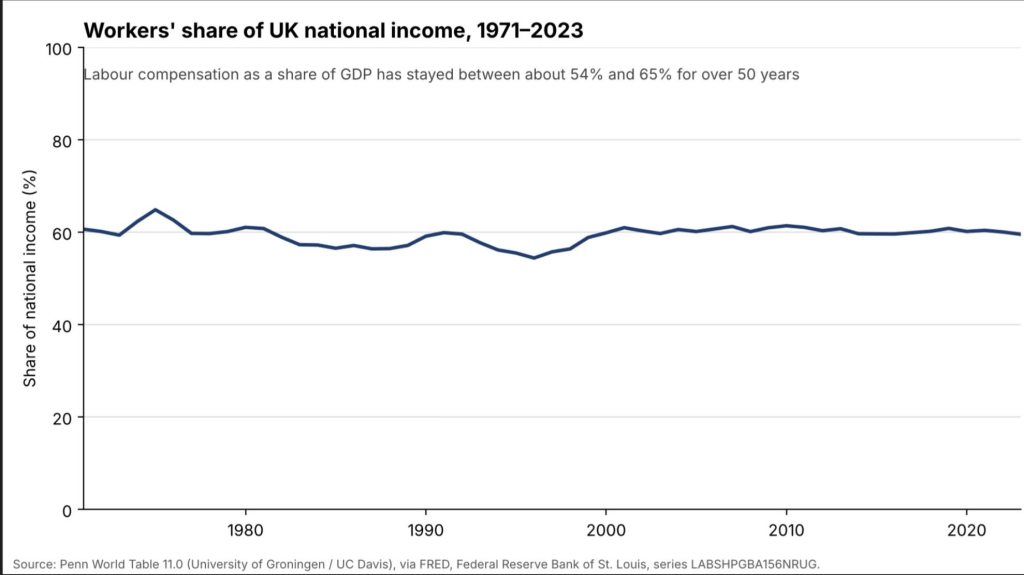
Falling wages raise a question that economists have usually been able to take for granted: when a new technology makes a country richer, who actually ends up with the extra money? Standard economics says you get paid roughly what your work adds. For most of the 20th century, the share of a country’s income going to workers, rather than to the owners of businesses and machines, stayed fairly steady (figure 1). The economist Nicholas Kaldor listed this as one of the basic facts about how economies behave. It held because new technology mostly helped people do their jobs better. A builder with a digger is more useful than a builder with a spade. AI is different, however. Rather than helping workers, it’s often sold as a way to replace them. If the AI is owned by a small number of big companies, the extra money it makes could go to those owners instead of to workers. That affects everyone. Owners tend to be wealthier, and wealthier people spend a smaller share of each extra pound they receive; economists say they have a lower marginal propensity to consume. So a shift in income from workers to owners could reduce total spending in the economy, or aggregate demand. Firms only hire workers to make the things people buy, so the demand for labour is a derived demand. If spending falls, firms need fewer workers, and unemployment rises, with all the problems that brings: lost income, wasted skills and pressure on government budgets.
Figure 1:
That is exactly the kind of outcome one of the most famous economists of the 20th century warned about almost a hundred years ago. In 1930, John Maynard Keynes predicted “technological unemployment”: machines doing so much that there wouldn’t be enough work to go round. For about a hundred years, economists said he was wrong, and they had a point. Machines kept destroying jobs, but things got cheaper, people got richer, they wanted new things, and new jobs appeared. The idea that there’s a fixed amount of work in the world (the “lump of labour”) is usually a mistake. But people always had somewhere to go next. Machines took over jobs that needed strength, so people moved into jobs that needed brains. If AI takes over brain work as well, where do we move? Possible answers may include jobs that need trust, someone willing to take responsibility, skilled hands, good taste, or real relationships. The open question is whether those could ever employ as many people as office and professional jobs do today. Many of those jobs, such as teaching, caring and medicine, are in services that technology has always struggled to speed up. William Baumol explained why that matters. He pointed out that a string quartet needs four musicians and about forty minutes, just as it did in 1800. You can’t speed it up. Factories have become enormously more efficient, but services like teaching and healthcare still need roughly the same amount of human time, and so remain very labour intensive. As a result, they become more expensive relative to everything else. This is called Baumol’s cost disease, and it’s one reason school fees and medical bills rise faster than the price of televisions.
AI might be the first technology that can speed up those sectors: helping doctors decide which patients to see first, giving every pupil a personal tutor, drafting legal documents. That could make them cheaper. On the other hand, if people decide they’d rather have a human teacher or doctor, those could turn into luxuries that cost even more. AI is not only changing what individual workers and services are worth. It may also change how the economy as a whole is organised, a question that has divided economists for a century. Friedrich Hayek argued that governments can’t plan an economy well, because the information you’d need is spread across millions of people, and much of it is in their heads. Prices are what pull that information together. AI doesn’t prove him wrong, but big companies now use algorithms to decide where their money and staff go, which is a kind of planning.
If algorithms can take on some of the work that markets used to do, that also changes the answer to another old question. Ronald Coase asked why companies exist at all. Why doesn’t everyone just work for themselves and trade? His answer was that doing deals in the open market is costly. You have to find people, agree a price and check the work. So it’s often cheaper to organise things inside one company.
AI makes both options cheaper at once, but not equally for everyone. Building a leading AI model takes huge amounts of computing power, data and money, yet once it exists, serving one more customer costs almost nothing. Huge fixed costs and tiny extra costs tend to favour a handful of giant firms, as they did with search engines and social media. At the same time, renting AI makes it far cheaper for a small team to find customers, draw up contracts and check work, the very costs that Coase said pushed people into companies. Meanwhile, much of what middle managers do, such as passing information up and down and checking other people’s work, is exactly what AI is getting good at. One likely result is a few giant companies that own the AI and the data, surrounded by lots of tiny teams that rent AI when they need it. Medium-sized companies with lots of managers could get squeezed in the middle.
If AI makes coordination and many kinds of thinking cheap, it is worth asking what is still expensive. That takes us back to the definition of economics itself. Lionel Robbins said economics is about choosing how to use things that are in short supply. AI makes some kinds of thinking almost free. Checking a contract or translating a document used to take a skilled person hours; now it can cost a fraction of a penny. However, scarcity doesn’t disappear. Rather, it moves: to computing power, electricity, valuable data, the ability to reach customers, permission from regulators, and whether people trust you.
Even if AI does reshape what is scarce, we may struggle to see the change in the numbers. In 1987 Robert Solow joked that you could see computers everywhere except in the figures measuring productivity. It took about ten years, and a lot of companies reorganising themselves, before the benefits showed up. AI might be going through the same delay, with an extra complication. Much of what AI gives us is free. If you use a free AI tool to help you revise, you benefit, but nobody paid for it, so it barely shows up in GDP. GDP was never a full measure of how well off people are: it counts what is bought and sold, not everything that makes life better. AI could raise people’s standard of living by more than GDP or other conventional measures suggest, even if other things, such as wages and employment, appear to get worse. So official figures could make growth look weaker than it really is, while making the damage look worse. That could push governments into the wrong decisions. If growth looks weak, a government might cut interest rates or borrow and spend to boost an economy that doesn’t need it, risking inflation. If it underestimates the benefits of AI, it might regulate or tax the technology so heavily that it slows down. And if it misreads where the damage is, support such as retraining could reach the wrong people, or arrive too late.
None of this means economics has to start again from scratch. People still respond to incentives. Prices still carry information. Competition still wears away big profits, given enough time. But many famous economic theories were built on a hidden assumption about workers: that they’re human, take years to learn things, can only concentrate on so much at once, and are the only things in the economy that can think. Take that assumption away and some conclusions change. Ricardo’s idea still means trade will happen, but not that people will earn enough to live on. Markets still gather information, but big organisations can now do some of that job too. Higher productivity still makes a country richer, but that doesn’t mean everyone will share in it. Adam Smith’s famous pin factory showed that splitting work into small tasks lets ordinary people, with ordinary limits, produce huge amounts. The coming decades will show what happens when those human limits are no longer what everything is built around. The economists who understand this best probably won’t throw out the old textbooks. They’ll go back through them, account for which ideas depended on assumptions about us, and use that to create new theories.

