
In November 1956, British paratroopers dropped into Port Said to take back the Suez Canal. Within days, Britain had agreed to a ceasefire and was on its way out, humiliated. It wasn’t the Egyptian army that forced the retreat, and it wasn’t the Soviets. It was America, Britain’s closest ally, and the weapon it pointed at London wasn’t a missile. It was a pile of bonds.
To see why that worked, you need to know what a bond actually is. When a government needs money, it borrows by selling bonds: pieces of paper promising to pay the holder interest and give the money back at a later date. Those bonds can then be bought and sold like anything else, and that is where it gets interesting. Imagine one investor holds a large amount of a country’s debt and suddenly sells it all. When investors sell bonds in large quantities, their prices fall and their yields rise, increasing the government’s cost of new borrowing and refinancing existing debt. Because the sellers are also dumping its currency, the currency can slide too. In other words, whoever owns a big chunk of your debt has their hand quite close to your throat. Being a lender sounds passive. It isn’t.
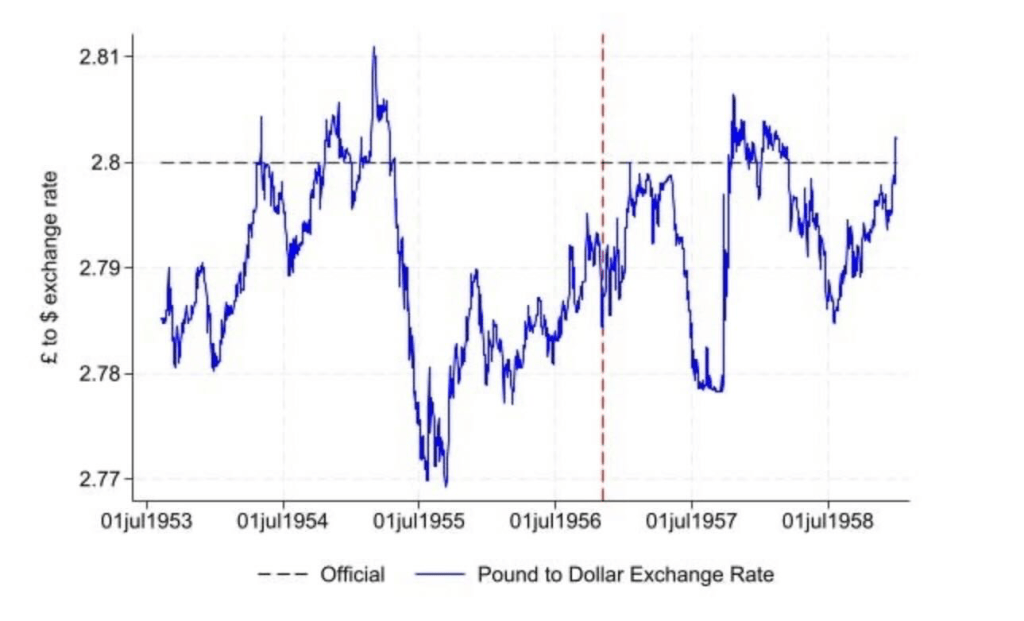
Suez is the clearest example of this ever actually being used. After Nasser nationalised the canal in July 1956, Britain, France and Israel invaded Egypt without telling Washington, and Eisenhower was furious. The pound was already under attack in the currency markets, and Britain needed help to defend it. Instead, the US blocked the International Monetary Fund from giving Britain $561 million in emergency credit. It also blocked a further $600 million from the US Export-Import Bank, and threatened to sell its holdings of sterling bonds, which would have sent the pound over a cliff. The ceasefire came into effect at midnight on 6 November. Suez is usually remembered as the moment Britain realised it was no longer a superpower, but it is just as much a lesson in finance: America didn’t need to fire a shot, because it held the paper.
Seventy years later, the version of this story everyone worries about is China and the United States. For most of the 2000s China bought US government debt, known as Treasuries, at an enormous rate, and by November 2013 its holdings had peaked at about $1.32 trillion. The fear in Washington was obvious. If Beijing ever wanted to punish America, over Taiwan for example, it could do to the US what the US did to Britain in 1956.
The problem with that plan is that the weapon would probably go off in China’s own hand. If China started dumping Treasuries, the price of the ones it hadn’t sold yet would collapse, so it would be destroying its own savings. The dollar would fall against the Yuan, making Chinese exports more expensive just as its own economy was taking the hit. And America, unlike Britain in 1956, borrows in its own currency and has a central bank that can step in and buy its bonds if nobody else will. Economists sometimes call this a “balance of financial terror”: each side can hurt the other, but only by hurting itself. It is less a gun than a grenade with a very short fuse.
What China seems to have done instead is quieter. The official figures show its Treasury holdings falling to about $618 billion by July 2026, less than half the peak, which leaves it behind both Japan and, rather surprisingly, the UK. But this is where the story turns into an actual spy novel, because nobody is completely sure those numbers are right. US data records where a bond is held, not who really owns it. Economists at the Council on Foreign Relations have argued that you cannot judge China’s real holdings just by looking at the line marked “China”. They think a good deal of Chinese money is probably sitting in custodial accounts in Belgium, at a company called Euroclear, where it shows up under someone else’s name. So China may not be disarming at all. It may just be keeping its weapon somewhere less visible.
That brings in the final twist, because Belgium also turns up in the other big debt story of the last few years. When Russia invaded Ukraine in February 2022, the US, the EU, the UK and others froze about $300 billion of the Russian central bank’s reserves, much of it held at that very same company, Euroclear. Russia had spent years building up those reserves as a war chest, and overnight it couldn’t touch a huge share of them. The main parts that stayed out of the West’s reach were reserves held in China and gold sitting in Russia’s own vaults.
This flips the whole idea of the debt weapon on its head. The old fear was that the lender could hurt the borrower by selling. The new reality is that the borrower can hurt the lender simply by refusing to give the money back. If you are a country that doesn’t get on with Washington or Brussels, owning their bonds no longer looks like power. It looks like a hostage situation, with your savings as the hostage. It is probably no coincidence that Russia has been shifting its remaining reserves out of dollars and euros and into gold, an asset no Western government can freeze with a signature.
So who really has the upper hand, the country that borrows or the country that lends? In 1956 the answer was obviously the lender, and Britain learned that the hard way. Today it is a lot less clear. America borrows more than ever, but it also controls the system that everyone else’s money flows through, and it has shown it is willing to use that. My own view is that the real weapon was never the debt itself. It was trust. Eisenhower could threaten Britain because Britain depended on American money. China and Russia are now quietly trying not to depend on anyone, and if they manage it, the next Suez might not be fought with bonds at all.
Bibliography
CEIC Data. “China Holdings of US Treasury Securities.” CEIC, 2026.
Congressional Research Service. “Russia’s War on Ukraine: Financial and Trade Sanctions.” Congress.gov, 2023.
Courthouse News Service. “The $300 Billion Hostage: Europe’s High-Stakes Gamble with Russia’s Frozen Fortune.” Courthouse News Service, 2025.
Fair Observer. “EU Freeze on Russian Assets Reshapes the Global Financial System and International Order.” Fair Observer, 2025.
Katz, David J. “Waging Financial War.” Parameters, US Army War College (2013).
Lambda Finance. “Foreign Holdings of US Treasuries by Country: 2026.” Lambda Finance, 2026.
National Army Museum. “Suez Crisis.” National Army Museum.
Setser, Brad. “Finding China in the U.S. TIC Data.” Council on Foreign Relations, 2026.

