
When you think about cryptocurrencies, what comes to your mind? To some it may be their widespread, uncontrollable volatility; the looming threat of an economic crash at any time; or a decentralized, secure, globally accessible currency independent of any person’s local government, to others it could act as a second chance for their own government’s mistakes, a lifeline you could say to the lesser fortunate. But what you may not have thought about is their unenforceable mandates acting as a double – edged sword while violating the flow of the economy and losing billions of dollars from venture capital investment lost. Another impact is harming countries such as Argentina and Turkey which are currently high-inflation economies where citizens heavily rely on to US – pegged stable coins where sudden mandates can trigger panic buying of black–market dollars or even further devalue these countries’ local currency. This is shown in Argentina’s Central Bank (BCRA) Crypto Banking Ban (May & July 2022) which was a sudden mandate banning financial institutions from offering any digital asset services. This led to spike in ’blue dollars’, an informal and parallel (Black Market) exchange for US dollars, while also leading to accelerated peso devaluation. Governments must find a balanced way to regulate crypto without harming the global economy, because the potential fallout of leaving crypto unregulated is far too high to ignore.
In the founding of crypto, the initial purpose was to create a fully decentralised “digital currency” with a limited supply while also preventing crises and protecting against inflation risk, such as the 2008 financial crisis, while, in the process, removing middlemen and allowing a digital place, isolated from government control, to store and invest your money. This idea has now become vulnerable, leading to contradictions between crypto’s own beliefs shown in European Central Bank Policy Speech: “Paradise lost? How crypto failed to deliver on its promises” (2023), where the ECB explicitly outlines how Satoshi Nakamoto, the pseudonymous founder of Bitcoin, envisioned a decentralized, low cost ‘peer to peer electronic cash system’ meant to replace intermediary banks for everyday payments; however, times have changed, leading to even more risks now, with widespread amounts of hacking and predatory fraud, as well as high network fees, slow processing speeds, and extreme volatility therefore pressuring governments to step in, stabilize and protect the market as well as maintaining their principle of “same activity, same risk, same regulation”.
A major complication in regulating the digital asset market is the profound reliance that citizens in high-inflation economies place on US-pegged stablecoins to protect their savings. Evidence from ‘The 2024 Geography of Cryptocurrency Report (Chapter: Latin America Crypto Adoption: The Rise of Stablecoins)’ showing that 61.8% of Argentina’s crypto trades and supply are currently in stablecoins. Unlike non – volatile economies and stable governments, for an Argentinian or Turkish resident, it is about gaining a paycheck and it is depreciating overnight; imagine earning something from hard work and it going to devaluing at the fault of seemingly insufficient monetary fluctuations; for them, it is not a choice to rely on digital assets, but an economic survival tool. Whilst this may sound disappointing that international governments are failing to protect the inhabitants of the hyper-inflationary countries, they could also be helping them. This idea of keeping and defending monetary sovereignty meaning that the local fiat currency if untreated and abandoned by the residents can cripple a nations ability to respond to these economic recessions leading to full dependence onto the stable coins which even they are not fully reliable, as in the gaining popularity and because traders lack knowledge onto these coins, we do not know the reliability of the recent eruption of the usage of digital assets or if the coin is “pegged” or backed by anything. This combined with the unpredictable use of algorithmic stablecoins, risking economic crippling debt.
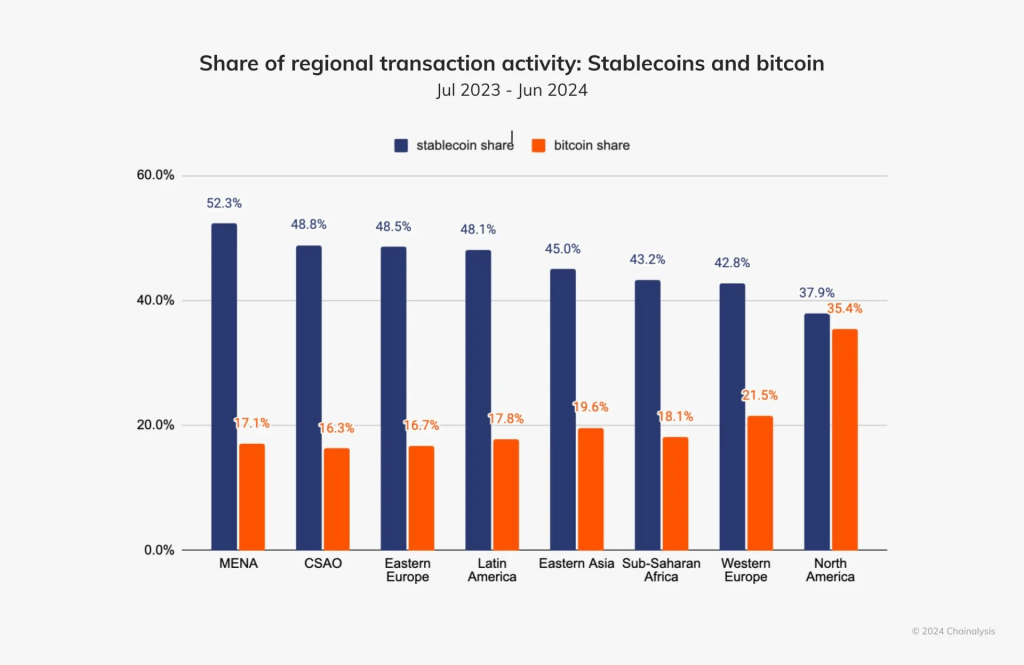
Figure 1: Global and Latin American stablecoin volume breakdown. Source: Chainalysis Research.. Source: www.chaincatcher.com

Figure 2: Local fiat notes layered alongside foreign currency. Source: Getty Images.. Source: Rmcarvalho / Getty Images
To resolve this regulatory gridlock, governments must shift away from blunt, reactionary bans and instead adopt adaptive, internationally coordinated frameworks. Rather than trying to eliminate decentralized networks which can drive users into riskier grey markets and black-dollar channels smart regulation should focus on transparency and accountability. For instance, policymakers can implement mandatory reserve audits for stablecoin issuers, ensuring that digital dollars are actually backed by vague liquid reserves rather than risky algorithms. By establishing clear, predictable guardrails that target predatory fraud and exchange hacks rather than unnecessarily restricting everyday users, international authorities can protect global financial stability while preserving the vital monetary lifelines that vulnerable populations abroad depend on.
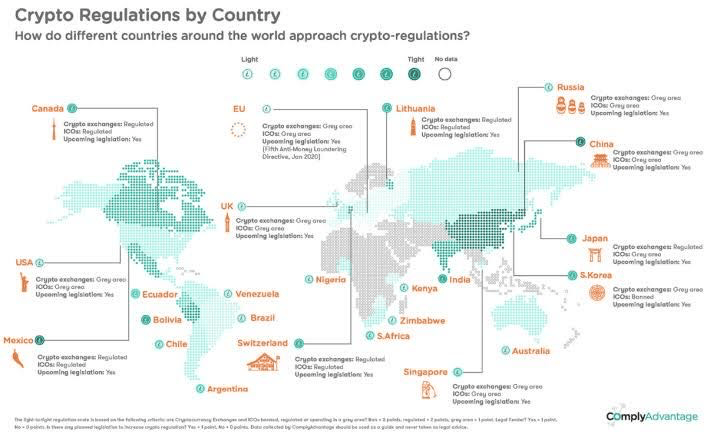
Figure 3: International policy approaches to crypto asset regulation. Source: ComplyAdvantage / Global Regulatory Frameworks.. Source: Visual Capitalist
Ultimately, the debate over cryptocurrency regulation is no longer just about protecting investors or preventing digital fraud; it is a complex global balancing act. While unchecked volatility and predatory hacks demand strict government oversight, blunt and heavy-handed bans threaten to destroy the essential financial lifelines that citizens in high – inflation economies rely on to survive. To break this real-time economic gridlock, policymakers must move past reactionary restrictions and embrace transparent, globally coordinated frameworks. Only by safeguarding monetary stability without stripping away individual financial security can governments successfully navigate the future of digital currency.
Bibliography:
Chainalysis Research. “The Geography of Cryptocurrency Report: Latin America and Emerging Markets.” Chainalysis, 2023–2024.
Financial Stability Board. High-Level Recommendations for the Regulation, Supervision and Oversight of Crypto-Asset Activities and Markets. Bank for International Settlements, 2023.
Federal Reserve Board of Governors. Interconnected DeFi: Ripple Effects from the Terra Collapse. Federal Reserve Discussion Paper, 2023.
President’s Working Group on Financial Markets. Report on Stablecoins. U.S. Department of the Treasury, 2021.
Chainalysis Research. “Latin America: How High Inflation and Capital Controls Drive Crypto Adoption in Argentina.” The 2022 Geography of Cryptocurrency Report, Chainalysis, 2022.
Do Rosario, Jorgelina. “Argentina Central Bank Bars Lenders from Offering Crypto Services.” Bloomberg News, 5 May 2022.
European Central Bank. (2023, June 23). Paradise lost? How crypto failed to deliver on its promises and what to do about it. ECB Speeches.
Allen, H. J. (2022, September). The superficial allure of crypto. IMF Finance & Development.
Chainalysis Research. “2024 LATAM Crypto Adoption: The Rise of Stablecoins.” The 2024 Geography of Cryptocurrency Report, Chainalysis, 9 Oct. 2024, www.chainalysis.com/blog/2024-latin-america-crypto-adoption/.

