
The difference between something costing a penny and nothing is numerically tiny. Yet when something becomes free, people become disproportionately attracted to it. Common daily offers such as free trials, free delivery, free samples and free apps differ in many ways, but they all rely on the same psychological pull towards what costs nothing. Why then does such a small change in price produce such a significant change in behaviour?
This phenomenon was analysed by Shampanier, Mazar and Ariely in a 2007 study exploring whether consumers would respond differently when a product became free. Participants were offered a choice between a low-quality chocolate (Hershey’s) and a high-quality chocolate (Lindt). In one scenario, Hershey’s cost 1 cent while Lindt cost 14 cents. In another, Hershey’s was free and Lindt cost 13 cents. When Hershey’s became free, the share of participants choosing it more than doubled, from 15% to 34%, while the share choosing Lindt fell from 38% to 16%. This challenges the traditional cost-benefit model, in which consumers compare the benefits they expect from a product with its costs. Since both prices fell by the same 1 cent, the difference between them was unchanged, so this model would predict almost no shift in preferences. This disproportionate response to a price of zero is known as the zero-price effect.
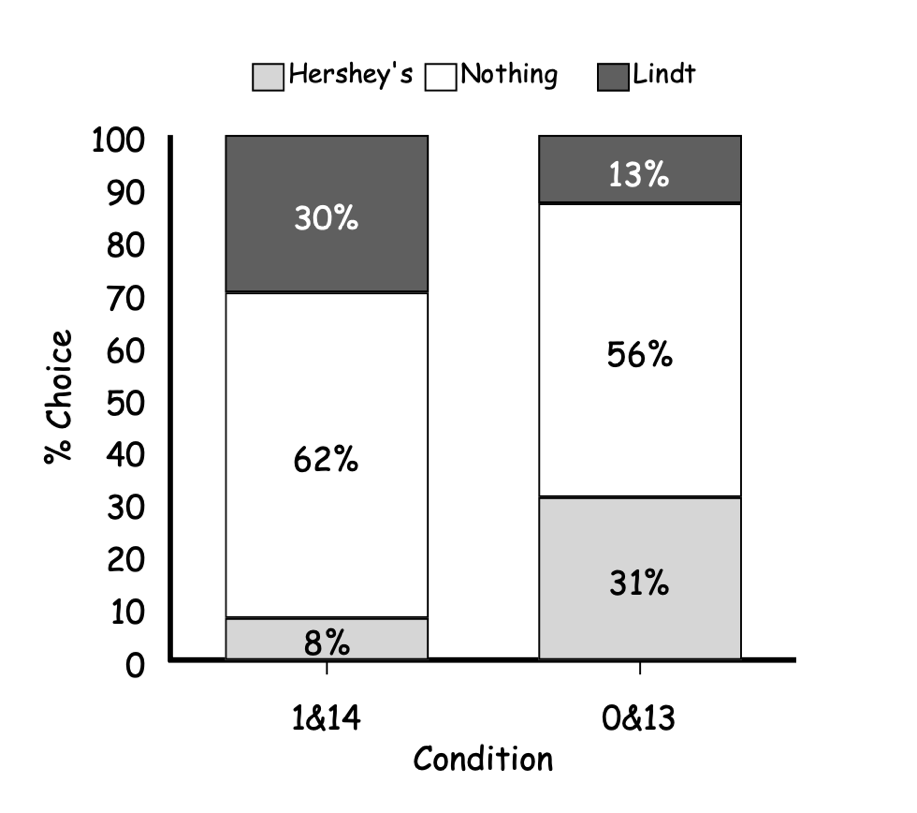
Figure 1: Share of participants choosing each chocolate when Hershey’s cost 1¢ and when it was free.
The chocolate experiment demonstrates this phenomenon, but why does it occur? The researchers proposed three possible explanations: social norms, mapping difficulty and affect. Although they investigated all three, affect emerged as the most plausible explanation for the zero-price effect.
Social norms are the unwritten rules of acceptable behaviour in a community. The hypothesis was that when an item costs money (even 1 cent), people follow market norms and feel entitled to take whatever they can afford, but when an item is free, social norms take over and people avoid looking greedy. Mapping difficulty is the psychological strain of translating a monetary cost into personal value. The theory was that because ‘mapping’ money to enjoyment is mentally taxing, consumers look for shortcuts. A price of zero requires zero mapping, as you don’t have to calculate whether something is worth the money when it costs no money. The researchers found these explanations less convincing. When they effectively paid participants a cent to take the Hershey’s, so that money was still involved, its popularity rose even further, which social norms cannot explain. The effect also persisted in situations where value was easy to judge, such as children trading Halloween sweets, which mapping difficulty cannot explain.
Affect is the immediate, automatic emotional reaction or ‘feeling’ caused by a stimulus. The researchers thought that the word ‘Free!’ triggers an intense, positive emotional response, and that this sudden burst of positive affect shifts our judgement, making the product seem more valuable and desirable. This emerged as the most likely explanation for two reasons. Participants rated the free option as making them far happier than any of the priced options. And when researchers asked participants to weigh up how much more they liked the Lindt and how much they disliked paying before choosing, the preference for the free item shrank so much that it was no longer statistically significant. In short, zero seems to be experienced not simply as a low cost, but as an emotional reward.
Companies have recognised the commercial potential of offering products for free. One way they exploit this is through the freemium business model, in which a company offers a basic version of a product or service for free while charging for additional features or a better experience. The free version removes the initial price barrier, allowing consumers to try the service; once they become regular users, some may decide that paying for extra features is worth it. For example, Spotify allows users to listen to music for free, while offering a paid Premium subscription. However, research by Joost Rietveld (2018), examining 343 PC games on Steam, found that freemium games were played less and generated less revenue than paid games. This shows the model’s main challenge: removing the price can also lower how much users value the product, so companies must still persuade enough of them to pay.
If a company’s service is completely free, then who is paying them? Free services such as Google or Instagram display advertisements, allowing them to generate revenue from advertisers rather than users. The users’ time and attention are valuable to advertisers since they want to reach potential customers. A free service can attract more users, creating a larger audience and making its advertising space more valuable. Being free also helps in another way: some services become more useful as more people use them. For example, a social network with 10 users isn’t very useful, whereas one with millions is. This is an example of network effects, where the value of a service increases as its user base grows (Katz and Shapiro, 1985). By offering their services for free, companies can build these large networks, making their platforms increasingly valuable.
While it may seem that free services have no cost, they actually do in the form of data. By offering a free service, companies such as Google or Instagram are able to collect information about their users, such as their interests and their online behaviour. This information is particularly useful as it allows personalised advertisements, which are more valuable to advertisers. However, there is often information asymmetry, where consumers may not fully understand the extent to which they share their data, or how it is being used (OECD, 2018). Instead of paying with money, consumers often pay with their data in exchange for a service.
Companies also use free to make people spend more money overall. An example of this is free delivery thresholds. Suppose an online shop offers free delivery on orders over £20, and a customer with a £15 basket sees that spending £5 more will get them free delivery. This incentivises them to buy another item to qualify, so they end up spending more than they originally intended, yet it can feel as though they saved money because they got free delivery. This is threshold-based pricing, where a benefit is only offered when spending reaches a specific level. This is supported by a 2006 study by Lewis, Singh and Fay, which found that the structure of shipping and handling fees, including free-shipping thresholds, influences both whether consumers buy and how much they spend.
While free is powerful, it does have some limitations. Customers may associate a free product with lower quality, making it less appealing, and sometimes the free version of a product is deliberately worse than its paid alternative. Free products can also involve costs in the form of time and effort. When these costs are high, a zero price can actually reduce demand compared with a low price (Fan, Cai and Bodenhausen, 2022). Making something free does not automatically make it desirable, as customers still value quality and usefulness. The zero-price effect is not a universal rule that everyone will choose a free alternative; it is a tendency that businesses and economists have identified.
£0 looks like the smallest possible price; however, it is often the most powerful. Zero is often seen not as just another price reduction but as a substantial change in the perceived attractiveness of a product. Businesses use this psychological response through freemium models, advertising and pricing strategies. Free often has an indirect cost, whether through more spending, attention or data. Perhaps the most interesting thing about free is not that we pay nothing for it, but how much our behaviour changes because we believe we pay nothing.
Bibliography
Fan, X., Cai, F. C. and Bodenhausen, G. V. (2022). ‘The Boomerang Effect of Zero Pricing: When and Why a Zero Price Is Less Effective Than a Low Price for Enhancing Consumer Demand’. Journal of the Academy of Marketing Science, 50(3), pp. 521–537.
Katz, M. L. and Shapiro, C. (1985). ‘Network Externalities, Competition, and Compatibility’. American Economic Review, 75(3), pp. 424–440.
Lewis, M., Singh, V. and Fay, S. (2006). ‘An Empirical Study of the Impact of Nonlinear Shipping and Handling Fees on Purchase Incidence and Expenditure Decisions’. Marketing Science, 25(1), pp. 51–64.
OECD (2018). Quality Considerations in the Zero-Price Economy. Paris: OECD.
Rietveld, J. (2018). ‘Creating and Capturing Value from Freemium Business Models: A Demand-Side Perspective’. Strategic Entrepreneurship Journal, 12(2), pp. 171–193.
Shampanier, K., Mazar, N. and Ariely, D. (2007). ‘Zero as a Special Price: The True Value of Free Products’. Marketing Science, 26(6), pp. 742–757.

