

Imagine waking up on a Thursday, going to bed that evening and waking up on Saturday. No Friday, no 24-hour countdown to the weekend — just an entire day wiped from the calendar. It might sound like something out of a science fiction movie. But in December 2011, this is exactly what happened in Samoa, a small island nation in the South Pacific. And the strangest part? The government did it in the hope of making the country richer. Most countries try to grow their economies by investing in infrastructure, improving education or encouraging businesses to expand. Samoa, however, decided to do something rather different: change the date.
For over a century, Samoa had been on the eastern side of the International Date Line, leaving it almost an entire day behind Australia and New Zealand, two of its biggest trading partners. Although the countries were relatively close geographically, their calendars were completely out of sync. When Samoan businesses opened on Friday morning, their Australian counterparts were already enjoying Saturday. And when Australian businesses returned to work on Monday, Samoa was still on Sunday. According to Samoa’s then-prime minister, this meant that businesses effectively had just three working days each week to deal with their trading partners. Imagine being a Samoan businessman trying to negotiate a deal with an Australian supplier. You send an urgent email on Friday, only to realise that your supplier has already left for the weekend. By the time they return to work on Monday, you’re still on your own weekend. A conversation that should have taken a few hours could end up taking several days. For an economy dependent on international trade, this was more than just an inconvenience. It was potentially costing businesses time, money and opportunities.
So Samoa came up with an extraordinary solution. At midnight at the end of Thursday, 29 December 2011, the country went straight to Saturday, skipping Friday 30 December entirely. In doing so, it moved to the western side of the International Date Line, bringing its working week into line with Australia and New Zealand. But could deleting a day from the calendar really make a country wealthier? One possible answer lies in something economists call transaction costs. These are the costs involved in making an economic exchange, whether that’s negotiating a contract, communicating with suppliers or arranging a delivery. Even something as seemingly insignificant as waiting for an email can become expensive when it happens thousands of times across an economy. By synchronising its working week with its main trading partners, Samoa hoped to reduce these costs. Businesses could respond to one another more quickly, shipments could be coordinated more easily and deals that previously dragged into the following week could potentially be completed in a matter of hours. In theory, this would make Samoan businesses more efficient and competitive, allowing them to trade more and potentially contribute to economic growth. All without building a single new factory or hiring a single extra worker.
However, there was one rather obvious problem. Samoa hadn’t actually created any more time. It had simply rearranged it.
While the change was designed to make trading with Australia and New Zealand easier, it also placed Samoa an entire calendar day ahead of neighbouring American Samoa, which remained on the other side of the International Date Line. For businesses trading on both sides of the International Date Line, the change was therefore not necessarily an improvement: making life easier for one group of trading partners made it more difficult for another.
There’s another important distinction that ought to be made. Saving time isn’t quite the same as making money. Just because a business can complete a transaction on Friday instead of Monday doesn’t automatically mean it will sell more products or earn higher profits. For Samoa’s decision to generate genuine economic growth, the improved efficiency would need to encourage additional trade, investment or production.
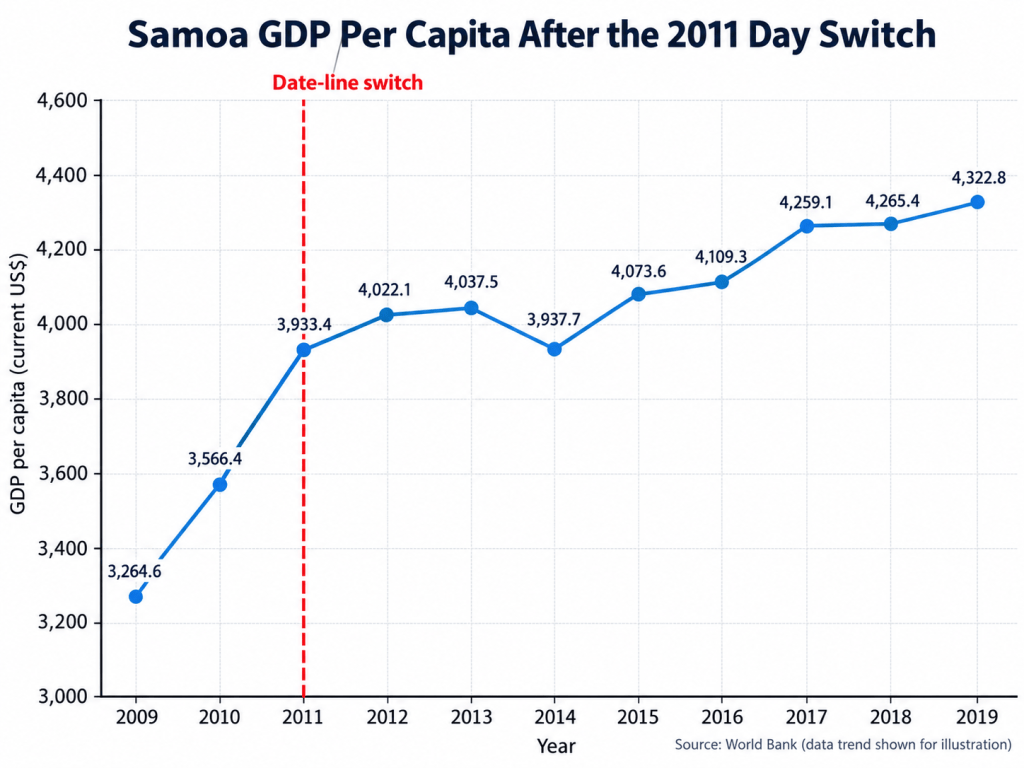
This makes measuring the success of Samoa’s experiment surprisingly difficult. While GDP increased after 2011, how much of that growth can actually be attributed to the time zone change? Samoa’s economy is influenced by tourism, international trade, remittances and countless other factors. Simply comparing GDP before and after the reform wouldn’t tell us whether changing the clocks had made the country richer. Nevertheless, Samoa’s decision raises a fascinating point about the way modern economies operate. We usually associate economic growth with having more of something: more workers, more factories, more technology or more natural resources. But what if a country could become wealthier simply by making better use of what it already has? After all, a factory doesn’t necessarily need more machines to increase production if it can eliminate unnecessary delays. Similarly, a business doesn’t always need more employees to generate additional revenue if it can communicate more efficiently with its customers. Samoa’s decision was essentially an attempt to apply this logic to an entire country. Rather than increasing its resources, it tried to remove an obstacle preventing those resources from being used effectively.
So, can a country really get richer by changing its time zone? Potentially. The economic benefits depend on who it trades with, how much time is wasted through poor coordination and whether eliminating those delays leads to greater economic activity. A time zone change alone is hardly a guarantee of prosperity. But the most interesting thing about Samoa’s experiment is how it challenges our understanding of economic growth. We often assume that becoming richer requires producing more, working harder or discovering something new. Yet sometimes, the greatest economic opportunities come from something much simpler: organising what we already have a little better.
Bibliography:
Australian Broadcasting Corporation (ABC) (2011). ‘Samoa approves dateline switch’. ABC News, 29 June. Available at: https://www.abc.net.au/news/2011-06-29/samoa-approves-dateline-switch/2776870
Australian Broadcasting Corporation (ABC) (2011). ‘Samoa skips Friday in time zone change’. ABC News, 30 December. Available at: https://www.abc.net.au/news/2011-12-30/samoa-skips-friday-in-time-zone-change/3753350
Meikle, J. (2011). ‘Samoa skips a Friday and goes back to the future side of dateline’. The Guardian, 28 December. Available at: https://www.theguardian.com/world/2011/dec/28/samoa-skips-friday-30-december
Rosenbaum, M. (2011). ‘Time Travel: Samoa and Tokelau to Move a Day Ahead’. ABC News, 29 December. Available at: https://abcnews.com/blogs/technology/2011/12/time-travel-samoa-and-tokelau-to-move-a-day-ahead/
Samoa Legislative Assembly (2011). International Date Line Act 2011. Government of Samoa. Available at: https://www.ag.gov.ws/wp-content/uploads/2024/02/International-Date-Line-Act-2011.pdf
Sky News (2011). ‘Samoans go travelling in time’. Sky News, 28 December. Available at: https://news.sky.com/story/samoans-go-travelling-in-time-10482389

