

Javier Milei took office in Argentina in December 2023, a time during which Argentina was facing one of the worst inflation crises in the world. Prices had risen 211.4% over the course of 2023; trust in the peso was close to nothing; the central bank had nearly run out of dollars; and the government was still holding an enormous deficit. Upon becoming President, Milei gutted public spending; devalued the currency; tore up subsidies; and let markets loose on sectors that had been tightly controlled for years. The first few months showed few positive results: inflation got worse; wages fell in real terms; poverty jumped; and the economy shrank. However, by 2025, the picture had flipped. Inflation had fallen and was continuing to do so; growth came back; and poverty had dropped a long way from where it had peaked.
A Problem Decades in the Making
Argentina has been cycling through inflation and currency crises for most of the last century. Between 1945 and 2014, annual inflation was below 10% in only 13 years and above 100% in 15 years. This shows us that Argentina is a country that has never quite managed to convince people its money and its finances are reliable.
Going into 2023, the fiscal deficit sat at about 4.4% of GDP, after a long sequence of running deficits since 2009. The deficits themselves were not the problem – plenty of countries borrow to cover a shortfall without wrecking their currency. Argentina’s issue was that after repeated defaults, nobody wanted to lend to it on normal terms so the government was forced to lean on the central bank to print pesos instead. If enough money is printed without the economy actually producing more, each peso buys less, and inflation worsens.
By this point, however, inflation was partly running itself. People stopped waiting to see if prices would rise; they just assumed they would. Workers pushed for raises to keep up with it. Businesses raised prices before their costs even went up. Property was priced in dollars and rents and contracts were indexed to inflation because nobody trusted the peso to hold its value for even a few months. Holding cash was a guaranteed, so people spent it fast or swapped it for dollars, which only added more fuel to the fire. On top of that, Argentina was running multiple exchange rates at once, most visibly an official one that was propped up artificially and a black-market “dólar blue” that reflected what people actually thought the currency was worth. Because many prices were set against the blue rate, every jump in it passed straight into prices. The whole system fed on itself: deficits meant more money printing, more money printing weakened the peso, a weaker peso made imports pricier, pricier imports pushed up prices and wage demands, and the expectation of more inflation kept the cycle going.
The shock
Having campaigned with a chainsaw as his symbol and a promise to slash spending and inflation, Milei won the second-round runoff on the 19th of November 2023 and was sworn in on the 10th of December. Markets started moving before he’d signed a single decree. Stocks and bonds rallied on hopes on hopes of reform while the black-market peso dropped about 12% on the first day of trading, as traders bet a devaluation was coming.
They were right. On the 12th of December, Economy Minister Luis Caputo devalued the official rate from 366.5 to 800 pesos per dollar, to close the gap between the official rate and what the peso was really worth. Public works were frozen, the number of ministries was cut and subsidies on energy and transport began to be stripped back.
The thinking behind it was not complicated, although the execution was brutal. Close the deficit and the government no longer needs to print money to cover it. Reset the exchange rate to realistic levels, because propping up an artificially strong peso was draining reserves the country did not have to spare. Finally, deregulate everything from rental rules and labour markets to trade barriers and price controls, on the theory that a lot of Argentina’s distortions came from the state getting in the way. What Milei did not do was try to control inflation by controlling prices directly. He went after the conditions that were causing it, which meant accepting that in the short term, prices would soar as the peso fell and subsidies were cut.
Why it worsened first
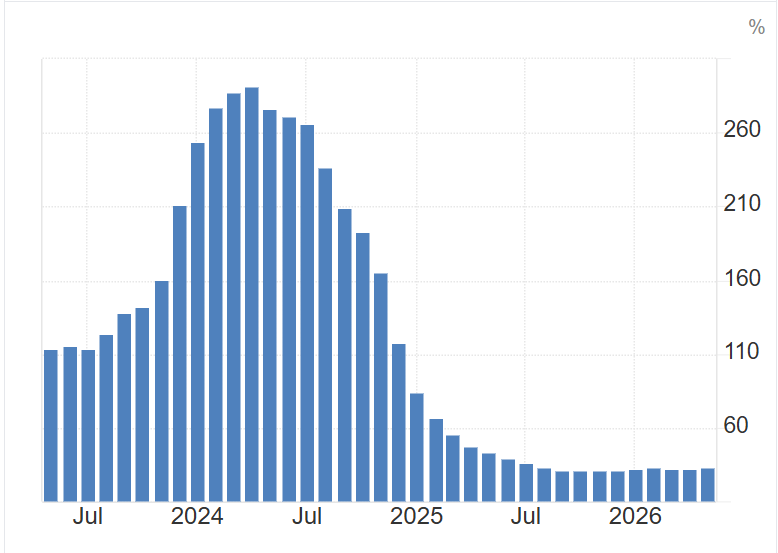
For most Argentines, the early months felt like free fall. Monthly inflation hit 25.5% in December, then 20.6% in January. By April, the annual rate had climbed to 289.4% (the peak on the graph above). None of this was unexpected. A currency that’s suddenly worth half as much makes every imported good and input more expensive, and businesses passed those costs straight through. Cutting subsidies had the same effect through a different channel: things the state used to help pay for now reflected their actual cost.
The reforms didn’t lower prices; they pushed the price level up sharply, at least at first. What they were meant to slow down was the pace of future increases. The social cost, however, was severe. Poverty hit 52.9% in the first half of 2024, and the economy contracted by 1.3% that year (initially reported as 1.7%) as households cut back, the government spent less and investment dried up. Milei was, essentially, choking off demand on purpose, betting that a smaller, weaker economy now was the price of a stable one later.
What actually turned it around
The thing that mattered most wasn’t the devaluation; it was that the government kept its word on spending. The cuts were deep enough to take Argentina from permanent deficits to actual surpluses and, by 2026, the IMF was noting two straight years of primary surpluses, the first stretch like that in 15 years. Once the deficit stopped needing to be financed by printing money, one of the main causes of inflation lost its fuel. The central bank backed this up in mid-2024 by stopping its own dollar purchases from expanding the money supply.
The exchange rate became the second piece of the puzzle. After the initial devaluation, the peso was allowed to slide at a steady, telegraphed 2% a month, a crawling peg that gave businesses something to plan around instead of bracing for another surprise devaluation. That pace slowed further to 1% a month in early 2025. In April 2025, the peg was replaced by a band that let the peso float between 1,000 and 1,400 per dollar, and currency controls on individuals were lifted.
Next, there was the simple fact that people had less money to spend. Real wages had fallen, the government was spending less and households were pulling back. Firms found it harder to keep raising prices when customers couldn’t and wouldn’t pay more, and workers had less leverage to demand raises.
The numbers tell this story clearly. Monthly inflation went from 25.5% in December 2023 to 13.2% by February 2024 and kept falling, reaching a low of 1.5% in May 2025. As the disinflation started to look real rather than temporary, businesses had less reason to raise prices pre-emptively and there was optimism surrounding the future of the Argentinian economy. From mid-2025, though, monthly inflation began creeping back up.
Growth comes back
2025 is where the case for Milei’s approach gets its strongest support. GDP grew 4.4% that year, with agriculture, mining and finance leading the way. Poverty, which had spiked to 52.9%, was down to 28.2% by the second half of 2025 according to Argentina’s own statistics agency, the lowest level since 2018, although some economists argue that the official measure, which relies on outdated price data, understates it. Although this all sounds conclusive, it can be argued that Milei got lucky. Agriculture, which led the rebound, was recovering from a 2023 drought that had knocked around 3 percentage points off GDP, and things could easily have gone the other way. The inflation spike could have destroyed confidence and sunk Argentina even further.
The downsides, however, cannot be shrugged off. Public jobs, subsidies and programmes were cut, and plenty of households are still worse off than they were. This raises the question of whether Milei was successful. Could it be seen as a J-curve, or have the gains been too uneven to count?
A shock arrives to test it
A test of Argentina’s new ‘stability’ came sooner than expected. The conflict involving the US, Israel and Iran rattled global energy markets in early 2026, pushing oil above $100 a barrel by March. Argentina’s monthly inflation ticked up to 3.4% that month, driven largely by regulated prices like utilities and transport, along with a seasonal jump in school fees. The government delayed a planned fuel tax hike to cushion the blow.
In the old Argentina, a shock like this could easily have spiralled. This time it didn’t. By August 2026, monthly inflation was back down to 1.7%, although it rose again to 2.2% in October and the annual rate was still a steep 33.1%. The shock doesn’t seem to have reversed the disinflation, but the disinflation had already stalled: annual inflation has been stuck at roughly 31–33% for about a year.
Has Milei actually fixed the spiral?
The answer depends entirely on what ‘fixing’ means. Set against where Argentina started, a whopping 211.4% annual inflation in 2023, briefly touching almost 290% in 2024, the result is impressive. Fiscal surpluses, a currency system that makes more sense and a strong rebound in 2025 are not small achievements. However, 30% inflation, which is roughly where forecasts for 2026 sit and barely below 2025’s 31.5%, is still extraordinarily high by almost any other country’s standards. Argentina’s position also still has weaknesses. Argentina needs reserves, investment and a government that doesn’t waver. A single slip on the fiscal side could put the peso back under pressure fast. Furthermore, surviving whatever the next external shock turns out to be is a different kind of test from pushing through an emergency programme in year one. Although inflation is often treated as the key macroeconomic objective, I don’t think that every other objective should be sacrificed to get it. Poverty is still high, unemployment has risen, many households struggle to feed their families and the living standard is low. After all this sacrifice, inflation is still high compared with other countries, leading to my conclusion that Milei’s reforms have not fixed Argentina’s economy, even if they may have stopped the inflation spiral.
Milei went after the deficit, the money supply, the exchange rate and a pile of price distortions more or less at once, and absorbed a brutal recession as the cost of making it stick. Whether that turns into a lasting fix or just another pause in a long cycle depends on whether Argentina can keep this up without leaning on recession or reimposing tight currency controls to hold inflation down.
References
211.4% annual inflation, 2023 (highest in 32 years) https://www.batimes.com.ar/news/economy/inflation-in-argentina-surpassed-211-in-2023-reveals-indec.phtml
25.5% monthly inflation, December 2023 / 20.6%, January 2024 https://learningenglish.voanews.com/a/argentina-s-inflation-rises-211-4-percent/7437750.html
188% average annual inflation, 1944–2026 https://tradingeconomics.com/argentina/inflation-cpi/forecast
3.4% monthly inflation, March 2026 / 32.6% annual https://www.bbvaresearch.com/en/publicaciones/argentina-monthly-inflation-rate-rose-to-34-in-march-the-highest-level-in-a-year/
1.9% monthly inflation, June 2026 / 33.5% annual https://en.mercopress.com/2026/07/14/argentina-s-inflation-slows-to-1.9-in-june-lowest-monthly-rate-in-10-months
30% inflation forecast for 2026 https://www.imf.org/-/media/files/publications/cr/2026/english/1argea2026001.pdf
GDP deficit, 2023 https://www.economicsobservatory.com/what-economic-challenges-does-argentina-face-today
Two consecutive years of primary fiscal surpluses by 2026 (first in ~2 decades) https://www.imf.org/-/media/files/publications/cr/2026/english/1argea2026001.pdf https://www.imf.org/en/blogs/articles/2026/07/31/argentina-looks-forward
12 December 2023: peso devalued from ~400 to 800 per dollar (Caputo) https://www.cnbc.com/2023/12/13/argentinas-economic-measures-devalues-its-currency-and-cuts-subsidies.html https://www.bloomberg.com/news/articles/2023-12-12/argentina-s-milei-devalues-peso-by-54-in-first-batch-of-shock-measures
2% monthly crawling peg, later slowed to 1% (Feb 2025) https://www.bloomberg.com/news/articles/2023-12-12/argentina-s-milei-devalues-peso-by-54-in-first-batch-of-shock-measures
Poverty 52.9%, H1 2024 (peak) INDEC, widely reported. https://www.batimes.com.ar/news/argentina/poverty-climbs-to-529-in-argentina-affecting-almost-25-million-people.phtml
GDP -1.7% in 2024 / +4.4% in 2025 Trading Economics (sourced to INDEC) and World Bank. https://tradingeconomics.com/argentina/full-year-gdp-growth https://www.worldbank.org/ext/en/country/argentina
Brent crude price per barrel https://www.cnn.com/2026/04/30/energy/oil-prices-iran-war-wartime-high-blockade-hnk https://finance.yahoo.com/sectors/energy/articles/oil-prices-hit-wartime-peak-122608911.html

